A solar light that shines all night in December can fade by ten o'clock in June, and the gap is widest in the south. This page gives the peak sun hours for 24 South African towns: what a flat panel and a panel tilted for winter receive in June and December, and the yearly average. The figures come from the European Commission's satellite radiation records, checked against NASA's. Use the June figure in the sizing calculator, and read why lights dim by July on solar garden lights and solar light repairs.
What a peak sun hour is
One peak sun hour is a kilowatt hour of sunlight on a square metre, the same as an hour of full midday sun. A day of 4 peak sun hours charges a panel as much as four hours at its rated output would, before losses. On a flat panel, June runs from about 4.2 in Limpopo down to 2.4 in Cape Town, where the winter rain and the low sun arrive together. December runs from about 5.2 in Pietermaritzburg to 9.0 in Springbok.
KwaZulu-Natal and the Lowveld lose summer sun to cloud and storms, so their December figure trails the dry west by a wide margin.
Tilt the panel for winter
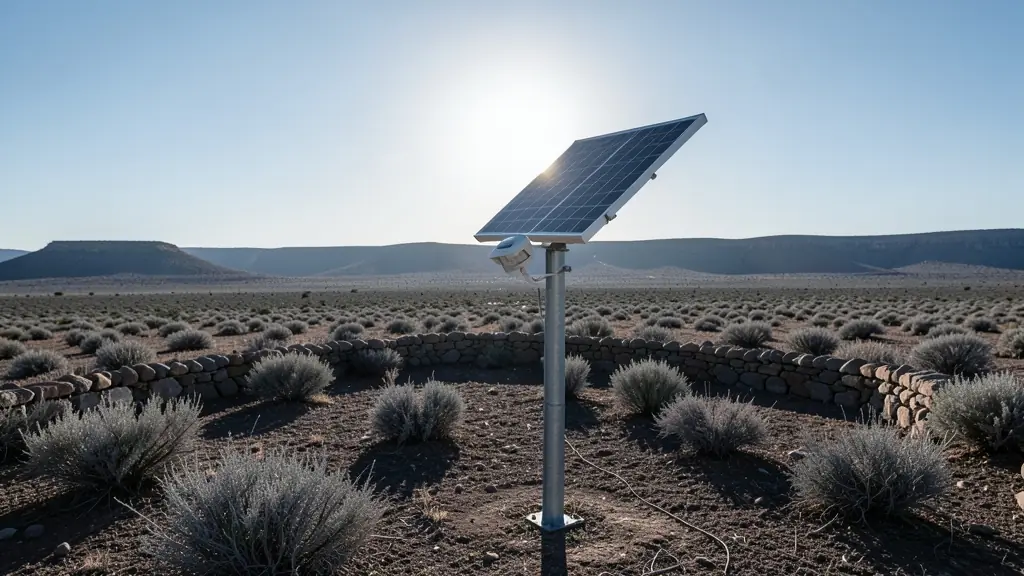
In South Africa a panel faces north. For winter, tilt it at your latitude plus 10 to 15 degrees: about 41 degrees in Johannesburg and 49 in Cape Town at plus 15, the angle the tool uses. That lifts Johannesburg's June figure from 4.0 to 6.5 and Cape Town's from 2.4 to 4.1. On a panel that steep, December becomes the weaker month in most towns, and it still beats flat June.
Many stake and wall lights have a flat panel on top. A model with a separate panel on a bracket can be aimed properly and gets 60 to 70% more charge in June.
What the figures leave out
These are long term averages for open ground. Shade from a wall, a tree or the eave of the house cuts charging far more than the difference between towns, and a panel on a north facing wall gets sun one on a south facing wall never sees. A run of grey days in the Cape winter, or a week of Highveld storm cloud in summer, can sit well below the average.
Dust, bird droppings and a scratched plastic cover take their share too. Wipe the panel once a month in the dry season.
Sources
- European Commission JRC, PVGIS 5.3 monthly radiation tool (API MRcalc): queried per town on 2026-11-24 at the coordinates in SUN: radiation database PVGIS-SARAH3, 2014 to 2023, horizon from the terrain model; monthly global irradiation on a horizontal plane, at the annual optimum angle and at a fixed angle of latitude plus 15 degrees facing north (aspect 180); monthly kWh/m² divided by days in the month gives kWh/m²/day, the same number as peak sun hours
- European Commission JRC, PVGIS user manual: PVGIS-SARAH3 (satellite, 2005 to 2023) is the default database in PVGIS 5.3 for Africa; 'a default value of 14% for the overall losses' of a PV system; monthly global horizontal and optimal angle irradiation in kWh/m²
- NASA POWER climatology API, all sky surface shortwave downward irradiance: cross check, horizontal, kWh/m²/day, climatology January 2001 to December 2025; Johannesburg June 3.95, December 6.80, year 5.58; every town within about 0.3 of PVGIS in June (TOOLS.md)
- Solar learning centre, how to calculate the solar panel tilt angle: winter: 'adding 15 degrees to your latitude'; summer: subtract 15 degrees; second method: latitude x 0.9 + 29 degrees for winter
Frequently asked questions
My town is not listed. Which figure do I use?
Why use June and not the yearly average?
Does a panel facing east or west work?
What happens after I send a request from this page?
More calculators
- Solar light sizing calculatorLumens and hours in, LED watts, battery Wh and panel W out
- Battery runtime calculatorHow many hours a battery runs a light, with dimming and motion mode
- Street light spacing calculatorRoad width and pole height to spacing, poles per 100 m and lumens
- Flood light coverage calculatorArea and use to target lux, lumens needed and how many floods
- Solar against wired cost calculatorTrench, cable and electrician against solar heads, with payback
- Battery replacement finderPick the cell in your light: what replaces it, and what never to use