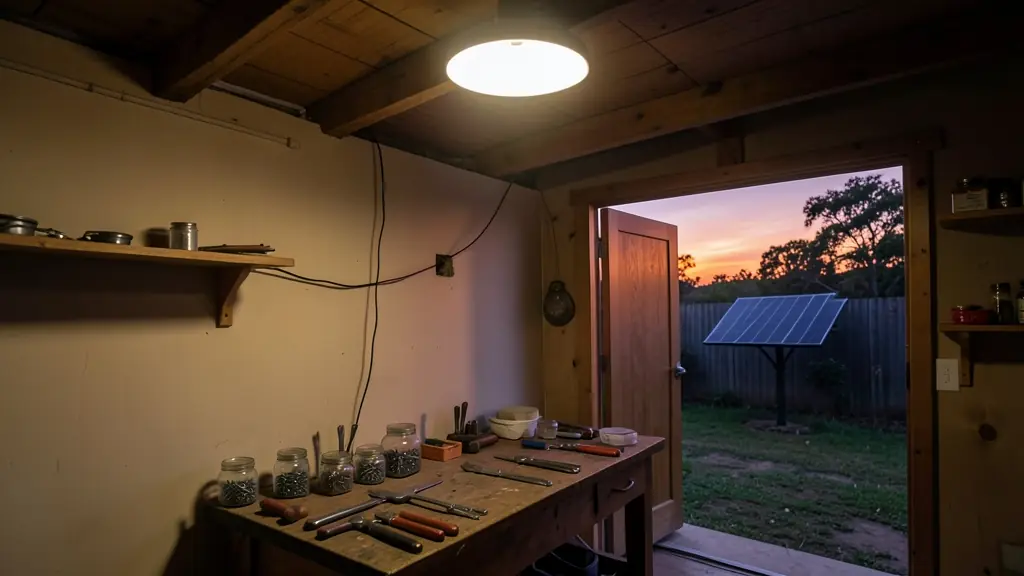
Indoor solar lights are a solar light with its panel moved outside: the panel goes on the roof or a north facing wall, a cable runs through the wall, and the light hangs from the ceiling with a pull switch or a remote. They suit a Wendy house, a garage, a storeroom, a backyard room in Soweto or a farm worker's cottage with no wiring. They also make a simple load shedding light for a passage or kitchen. What they cannot do is charge on a windowsill.
Why a windowsill does not work
Window glass, tinting and burglar bars cut the light reaching the panel, and a sill gets direct sun for only part of the day. A panel behind glass may collect a fraction of what it would outside. That is why proper indoor sets come with a separate panel on 3 to 5 m of cable, or longer. Mount it on the roof or a wall that faces north, clear of the shade of gutters, trees and the neighbour's double storey. In winter, check how many sun hours your town gets.
What kind of indoor set suits the room
- Single ceiling light with a pull cord. One panel, one light, 200 to 500 lm. A storeroom, a toilet outside, a garage corner.
- Remote ceiling light. Same, but switched and dimmed from a small remote; handy in a bedroom or a shack where the light sits high.
- Two to four bulbs from one battery box. A small kit that lights a room or two and charges a phone. See solar light systems for the home.
- Pendant shed lights. A long bar or tube on a hook for a workshop bench.
Getting the cable inside neatly
Drill one hole just big enough for the cable, slope it slightly downwards to the outside, and seal it with silicone so rain does not follow the cable in. Clip the cable along beams or skirting rather than leaving it loose. On a corrugated iron roof, fix the panel bracket to the purlins with roofing screws and rubber washers. If anything in the room is wired to the mains, leave that to a registered electrician; these lights stay on their own low voltage circuit.
How long the light will last
A 300 lm ceiling light draws roughly 2 to 3 W. To run it 5 hours a night with a spare cloudy day, the battery needs to hold about 25 to 30 Wh. Many cheap sets have far less, so ask for the battery in Wh or mAh at a stated voltage. A LiFePO4 pack lasts longer than lithium ion when the battery box sits in a hot tin roof room. Work out your own numbers with the sizing calculator and read about cells on batteries for solar lights.
What to put in your request
- Say which room and how big it is
- Give the distance from the light to the panel spot
- Say what the roof is made of
- Say how many hours a night you need light
- Ask for the cable length and battery size in writing
Indoor Solar Lights: who asks for them and why
- Homeowners and tenants: a Wendy house, the garage, the outside toilet or a passage light for load shedding
- Estates, complexes and body corporates: guard huts, refuse rooms and pump rooms where nobody wants to run new cable
- Farms, smallholdings and lodges: a worker's cottage, the tack room and the feed store far from the main house
- Shops, guesthouses, churches and offices: storerooms, a church hall kitchen and a spaza shop that opens before sunrise
- Municipalities and public contractors: informal settlement homes and community container offices without a connection
- Schools, clinics and sports clubs: rural classrooms, storerooms and the caretaker's room during power cuts
- Mines, depots, yards and sites: site containers, toolsheds and switch rooms on construction and telecom sites
- Venues, events and campsites: tents, back of house containers and a bush camp's ablutions