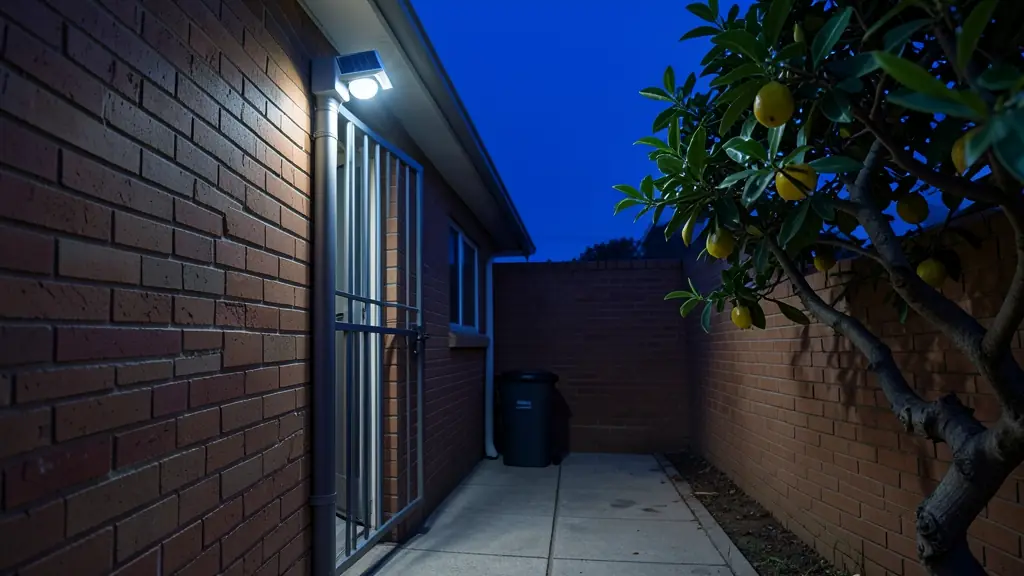
Solar lights with a motion sensor are the answer to a small battery and a long winter night. Instead of burning all its stored energy by ten o'clock, the light waits in the dark or at a faint glow, then jumps to full output when the sensor sees someone at the side gate, the bins or the back door. Set up well, a modest light in Randburg or Pinetown still has charge at five in the morning; set up badly, it fires for every branch and dies by midnight.
How the sensor eye decides
Almost every unit uses a PIR (passive infrared) sensor, the white dome under the head. It reads warmth moving across its zones, so a person or a dog sets it off while a sun warmed wall does not. Some heads use microwave radar instead, which catches smaller movement and more false alarms.
Boxes usually claim a 5 to 8 m range and a 90 to 120 degree spread. Someone walking straight at the eye is seen late; someone crossing its view is seen early, so aim it across the path.
The three modes on the switch
- Off until motion. Dark until someone moves, then full output for 20 to 60 seconds. Longest battery life by far, the right pick for a side passage or a gate.
- Dim, then bright. A low glow all night, full output on movement. Good for a stoep or a path where you want to see the way without waking the neighbours.
- Always on. Steady medium light with no sensor at all. Only worth it with a large battery and a panel in full sun.
Dim then bright is what most people choose, and it drains a weak light fastest in June. If yours dies early, try off until motion before blaming the battery.
False triggers and where they come from
- Branches swaying in the wind, warmer than the night air around them.
- Dogs and cats on patrol. Mount higher and tilt the eye down onto the path, not the lawn.
- Cars on the street when the head looks over a low wall.
Each false trigger burns up to a minute at full output; fifty a night empty the pack as surely as leaving it on. For a security light on a perimeter, ask for a head with sensitivity and timer settings, or a remote.
Sizing the battery for sensor mode
A 1,000 lm head burning for 12 hours needs a big pack; the same head firing 40 times for 30 seconds uses a sliver of that. Put your likely triggers into the battery runtime calculator. On a south facing wall or under a deep eave, pick a wall light whose panel sits apart on its own lead, out in the sun.
What to put in your request
- Where each light goes and what it must see
- The mode you want: off, dim then bright, or on
- Which way the wall faces and any eave above
- Dogs, trees or a street in the sensor's view
- How many lights and whether you want installation
Motion Sensor Solar Lights: who asks for them and why
- Homeowners and tenants: a side gate, the wheelie bins and the back door lit only when someone is there
- Estates, complexes and body corporates: unit entrances and refuse areas in a complex that stay dark until a resident walks up
- Farms, smallholdings and lodges: the feed store and the gate to the kraal waking up when the farmer walks out at night
- Shops, guesthouses, churches and offices: a guesthouse's back entrance or a shop's loading door lit for staff arriving before dawn
- Municipalities and public contractors: public toilets and clinic side doors in parks where all night lighting would empty a small pack
- Schools, clinics and sports clubs: classroom block corners and the path to the hostel that light up as learners pass
- Mines, depots, yards and sites: storeroom doors on a construction site that switch on when the guard does his rounds
- Venues, events and campsites: a path to the bathrooms at a campsite or a venue that lights only when guests walk it