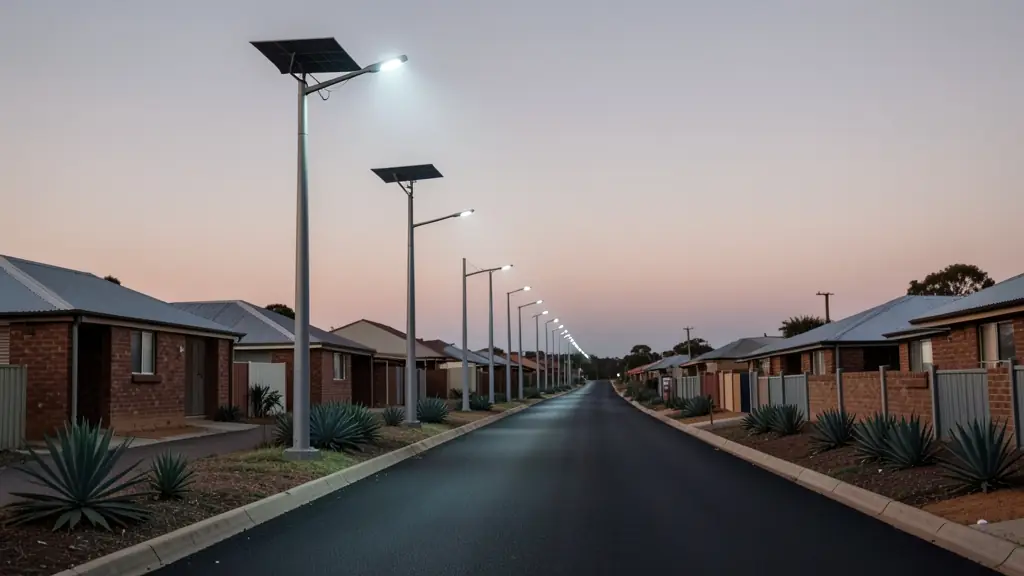
Solar street lights are now a normal sight on rural roads, estate entrances and the edges of new housing projects across South Africa. A street light is a tougher job than a garden light: it must give 2,000 to 8,000 lm from a pole 6 to 9 m up, every night of the year, through three grey days in a row, and survive people who want its battery. This page covers the two system types, pole height and spacing, battery autonomy, theft and what the municipality needs to see.
All in one heads or split systems
An all in one head has the panel, battery and LEDs in a single housing on top of the pole. It is quick to fit and has no cables to steal, but the battery sits up in the heat and the panel is only as big as the head allows. A split system has a larger panel on a bracket, the battery in a box on the pole or buried at the base, and a separate LED head. It costs more and takes longer to install, but it runs brighter and longer and the battery is easier to service. For a quiet estate road, all in one usually does. For a main road, a taxi route or a cloudy coastal area, ask for a split quote too.
Pole height, spacing and the road
- Paths and parking: 3 to 4 m poles.
- Estate and farm roads: 4 to 6 m.
- Public streets: 6 to 9 m.
Spacing is roughly 3 to 4 times the pole height, so 8 m poles land about 25 to 30 m apart. Wide roads and intersections need closer spacing or poles on both sides. The street light spacing calculator gives poles per 100 m for your road width.
Three dark days in the battery
A street light cannot simply go out when the weather turns. Tender specs usually ask for two to three nights of autonomy: the battery runs the head for that long with no charge at all. Most good heads dim to 30 or 50 percent after midnight and brighten on motion, which is how the battery covers a wet week in the Eastern Cape. Ask for LiFePO4 cells, the Wh figure, and the panel watts. Check your area with the winter sun hours tool.
Theft, vandals and the foundation
Batteries and panels get stolen. Ask for anti theft bolts, a lockable battery box, panels mounted high and a pole without footholds. A pole of 6 m or more needs a proper concrete foundation with anchor bolts, sized by the supplier or an engineer for the soil and the wind. Before a pole goes into a road reserve, get written consent from the council; each municipality writes its own lighting spec for public streets. For complexes, see solar lighting for estates.
What to put in your request
- Give the road length and width in metres
- Say one side or both sides of the road
- Ask for two or three nights of autonomy
- Say if poles and foundations are included
- Name the town and who owns the road
Solar Street Lights: who asks for them and why
- Homeowners and tenants: a single tall head at the end of a long private road or a smallholding gate
- Estates, complexes and body corporates: internal road poles for a complex, with dimming after midnight to stretch the battery
- Farms, smallholdings and lodges: poles along the farm road, at the workers' houses and at the main gate
- Shops, guesthouses, churches and offices: street style heads for a large car park at a church, school or shopping strip
- Municipalities and public contractors: tender quantities of heads and poles for informal settlements, rural roads and parks
- Schools, clinics and sports clubs: poles along the entrance road and around the sports field for evening use
- Mines, depots, yards and sites: haul road and perimeter road poles at mines, depots and long term site camps
- Venues, events and campsites: temporary poles on ballast bases for a festival site or a showground road