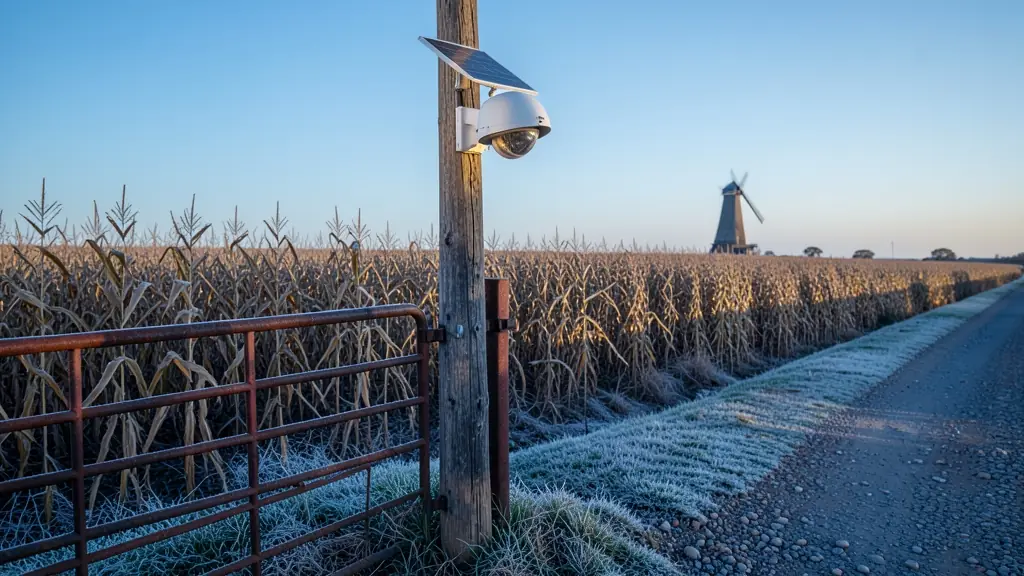
Solar lights with camera combine a floodlight, a small camera, a battery and a panel in one housing, so you can watch a gate, a shed or a building site where there is no power point and no cable. They suit a farm gate near Bethal, a site office on a new estate, or the back of a holiday house in the Karoo. They also ask a lot of a small battery, and they depend on a signal reaching them. Here is what to check before you buy one or a dozen.
Wi-Fi or a 4G sim
A Wi-Fi unit needs your router's signal at the mounting spot, at night, through walls. Test it with your phone standing exactly where the unit will hang: two bars in the kitchen often become none at the boundary. A booster or a mesh point outside fixes many homes. A 4G unit takes a data sim and works anywhere there is cellular coverage, which suits farms and building sites, but it costs data every month and video uses a lot of it. Ask how many megabytes a day the unit uses on motion recording only.
Why the camera drains the battery
An LED that runs only when triggered uses little energy. A camera that listens for motion all night, wakes its radio, sends clips and powers infrared LEDs uses far more. That is why most units record on motion only, not around the clock. Cheap units with a tiny panel go flat after two cloudy days in the Cape winter. Ask for:
- The pack capacity in Wh, or its mAh together with its voltage.
- The panel size in W, and whether it can be moved on a cable.
- How many triggers a night it handles on a full charge.
The battery runtime calculator shows how quickly extra load adds up.
Storage, night vision and what you actually see
Clips go to a memory card inside the unit, to a cloud account, or both. A card is free but leaves with the camera if someone steals it; cloud storage survives theft but often needs a subscription. At night the camera either switches to black and white infrared or uses the floodlight for a colour picture. Infrared reaches further but faces are harder to read. Set the expectation: these cameras show that someone came through the gate and roughly what they looked like, not a number plate at 20 m.
Where wired CCTV still wins
A combined unit is a good fix for one or two remote spots. For a whole house, a shop or an estate gatehouse, a wired camera system with a recorder and backup power records continuously, keeps footage on site and does not depend on sun. Many people end up with both: wired cameras near the house, and solar units at the far gate. For lights without a lens, see solar security lights and motion sensor solar lights.
What to put in your request
- Say whether Wi-Fi reaches the spot or a sim is needed
- Say how far the gate or shed is from the house
- Card, cloud or both for storage
- How many units and what height they mount at
- Ask whether the panel can sit apart on a cable
Solar Lights With Camera: who asks for them and why
- Homeowners and tenants: the far gate, the back corner or a holiday house watched from your phone
- Estates, complexes and body corporates: a remote service gate or a construction phase boundary before cabling arrives
- Farms, smallholdings and lodges: the main farm gate, the diesel tank and the pump house with a 4G sim
- Shops, guesthouses, churches and offices: a rural guesthouse entrance or a storeroom across the yard from the office
- Municipalities and public contractors: illegal dumping hot spots and park storerooms where trenching is not an option
- Schools, clinics and sports clubs: a sports pavilion or a storeroom on the far side of the grounds
- Mines, depots, yards and sites: site offices, plant yards and material stockpiles on new construction projects
- Venues, events and campsites: the gate and the equipment store at a venue between events