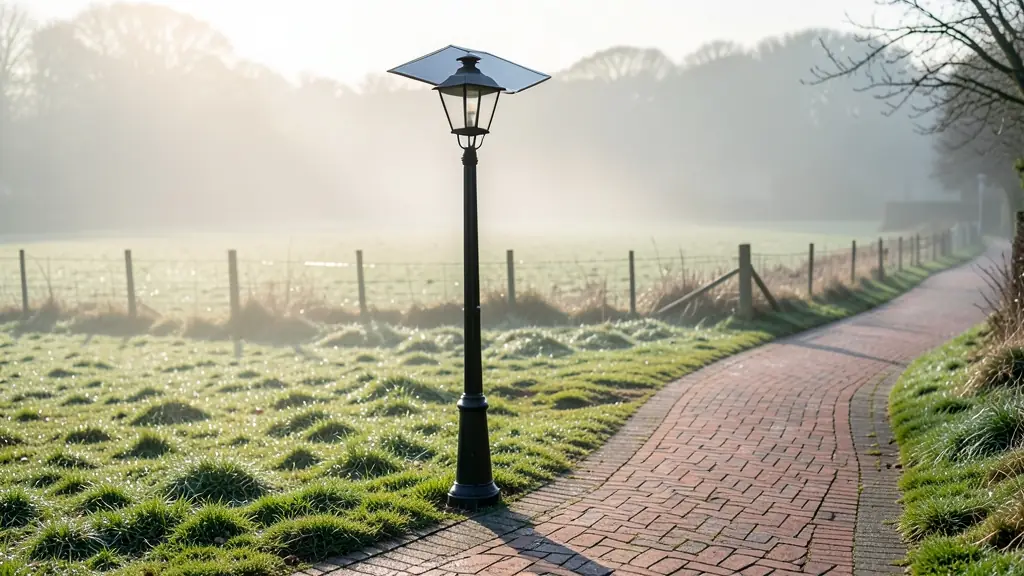
Solar pole lights sit between a garden stake and a street light. A black lamp post with a lantern head beside a Midlands farmhouse path, a short post along the walkway to a clubhouse in Centurion, a cap on top of each brick gate pillar in Durbanville. The panel sits on the head or on a small bracket, the battery hides in the head or the pole, and there is no cable back to the house. What you are really buying is the height: a light at 2 to 4 m throws a wider circle than anything on a spike.
Three kinds of solar light on a pole
- Garden lamp posts. A 2 to 3 m post with a lantern or globe head, mostly decorative, often 200 to 600 lm.
- Path and walkway posts. A 3 to 4 m post with a plain functional head of 800 to 2,000 lm, spaced along a route.
- Post tops and pillar caps. A head that slides over a round post or sits on a flat brick pillar, with no pole of its own.
For estate roads at 4 to 6 m and streets at 6 to 9 m, you are into solar street lights, a different class of head and pole.
Decorative or functional
A frosted lantern head looks right on a farmhouse lawn but loses light inside the glass; a plain head pointing down puts more on the path. Decide whether the post is there to be admired or to light a route. A guesthouse compromise: a lantern style head with its LED board aimed down.
Along a path, space posts three to four times their height apart, so a 3 m post every 9 to 12 m. The spacing calculator works it out for your length.
Setting the pole
- For a 3 m garden post, dig roughly 300 mm square and 500 to 600 mm deep; taller posts go deeper.
- Cast the supplier's anchor bolts or the pole's spigot into concrete.
- Level it both ways before the concrete sets, and let it cure before the head goes on.
On sandy coastal soil or a clay slope, ask the supplier for the foundation size in writing. A pole on a public pavement or road reserve needs the council's permission first.
Pillar caps on a brick wall
Gate pillars are the easy win. A cap light bolts onto the flat top with brick plugs, and a pillar usually gets sun from at least one side. Check that the cap fits the pillar's size, commonly 230 mm, 340 mm or 450 mm square, and that the panel faces north. For the turn in from the street, see solar driveway lights.
What to put in your request
- The length of the path or how many posts
- Pole height and whether the pole is included
- Lantern style or plain head pointing down
- Soil and surface: lawn, paving, sand, clay
- Pillar size if you want caps on a brick wall
Solar Pole Lights: who asks for them and why
- Homeowners and tenants: a lamp post beside the front path and caps on the gate pillars with no trench dug
- Estates, complexes and body corporates: a line of 3 m posts along the walkway between units and the clubhouse in a complex
- Farms, smallholdings and lodges: a post at the farmhouse gate and another at the kraal where the cable never reached
- Shops, guesthouses, churches and offices: lantern posts along a guesthouse path or a church walkway to the hall
- Municipalities and public contractors: short posts along a park footpath or a taxi rank walkway where trenching is costly
- Schools, clinics and sports clubs: walkway posts between classroom blocks and the hostel for learners after evening study
- Mines, depots, yards and sites: posts along the footpath from a site office to the gate on a temporary yard
- Venues, events and campsites: lantern posts set along a wedding venue's garden path and kept for the next season