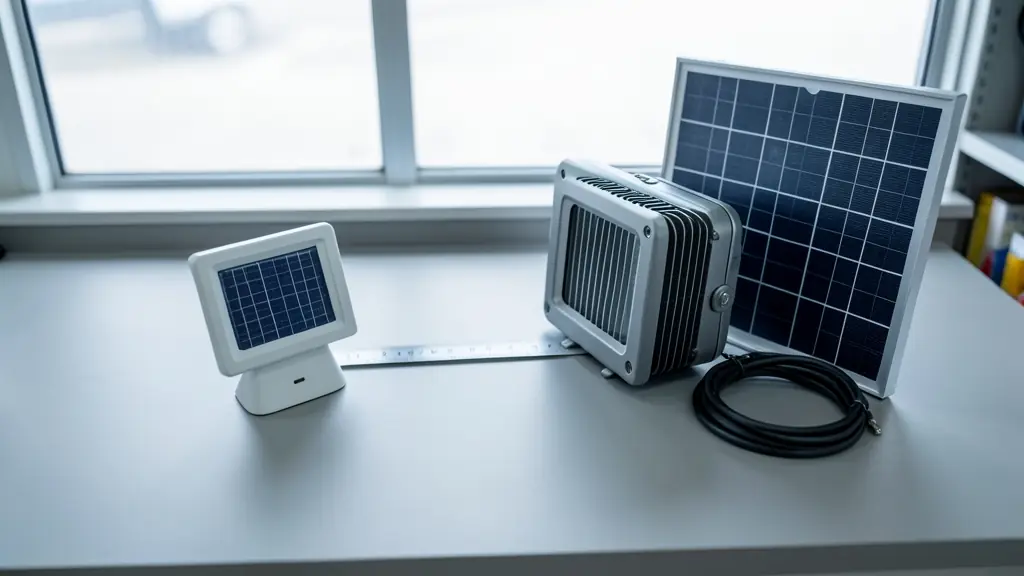
Ask three suppliers for a solar lights price and you can get three answers that are ten times apart for what looks like the same flood. The box is not the guide: the real lumens, the battery in watt hours, the panel size, the housing and the warranty are. This page shows what pushes a price up or down, how to compare cheap and commercial grade honestly, and what else goes on the bill for a whole job.
Five things that set the price
- Real lumens. A tested light output, not a "watts" claim printed big on the box. LEDs give roughly 100 to 150 lm per watt, so a true 1,500 lm flood has an LED near 10 to 15 W.
- Battery capacity. Given in watt hours, or in mAh with the voltage beside it. The pack is usually the biggest cost inside the light and the main reason one lasts till dawn and another fades by ten.
- Panel size. A bigger panel refills the battery on a short Cape winter day. A tiny one cannot.
- Housing. Die cast aluminium that sheds heat and stands up to hail costs more than thin plastic.
- Warranty and support. A supplier who swaps a failed battery in year two has priced that in.
Cheap versus commercial grade
A cheap marketplace light is fine for a garden marker you will replace in a year. For a driveway, a yard or a street head, the sum that matters is cost per year of useful light. A commercial grade fitting with a LiFePO4 pack, sized for a winter night plus a cloudy day or two, often works out cheaper over five years than buying the cheap one four times. Use the solar light sizing calculator to see the battery and panel a winter night really needs.
Price per lumen night
To compare two lights fairly, divide the price by the lumens it gives and the hours it keeps them up on a winter night. A light that holds 800 lm for ten hours beats one claiming 3,000 lm that drops to a glow by midnight. Ask each supplier for the run time at full and at dimmed output, and check it against the battery runtime calculator.
The total for a job, not just the light
- Poles, brackets or pole top adaptors.
- Foundations and concrete for anything on a pole.
- Labour and equipment hire for height, covered under solar light installation.
- Delivery to site, especially to a farm or a town far from a metro.
- VAT, and whether the quote includes it.
Buying fifty or more? The unit price usually falls with the count; see solar lights wholesale.
What to put in your request
- The kind of light and how many
- The area to light and hours a night
- Your town, for winter sun and delivery
- Whether poles and installation are wanted
- Ask for tested lumens and battery Wh
Solar Lights Price: who asks for them and why
- Homeowners and tenants: pricing floods for the driveway against a cheaper box that may not last a winter
- Estates, complexes and body corporates: trustees comparing per head prices and five year cost before taking it to the levy budget
- Farms, smallholdings and lodges: the cost of solar floods at a far shed against trenching cable from the house
- Shops, guesthouses, churches and offices: a church or shop pricing car park lights with poles, installation and VAT included
- Municipalities and public contractors: a contractor pricing street heads per unit for a tender with delivery to the ward
- Schools, clinics and sports clubs: a governing body weighing a quote for walkway lights against the year's maintenance budget
- Mines, depots, yards and sites: procurement comparing commercial heads for a laydown yard on cost per year of light
- Venues, events and campsites: a planner pricing lanterns and festoons to buy against hiring them for one wedding