A good solar light installation is mostly about where the panel points and what holds the light up. Three garden stakes need nobody. A flood on the eave of a double storey needs a ladder, the right anchors and someone happy at height. A row of street heads needs foundations, a pole supplier and often a council's say. Here is who does which job, what they should check on the day, and what a fair quote lists.
Who installs which kind of light
- Yourself or a handyman: stake lights, wall lights and small floods on brick or timber below about 3 m.
- A solar installer or lighting supplier's team: floods with separate panels, security lights along a boundary wall, pole top lights on a gate.
- A street lighting contractor: poles from 4 to 9 m, foundations, cranes or a cherry picker, an estate road or a public street.
- A registered electrician: anything connected to the mains, such as a hybrid light with a grid backup, which needs a Certificate of Compliance.
Poles, foundations and anchors
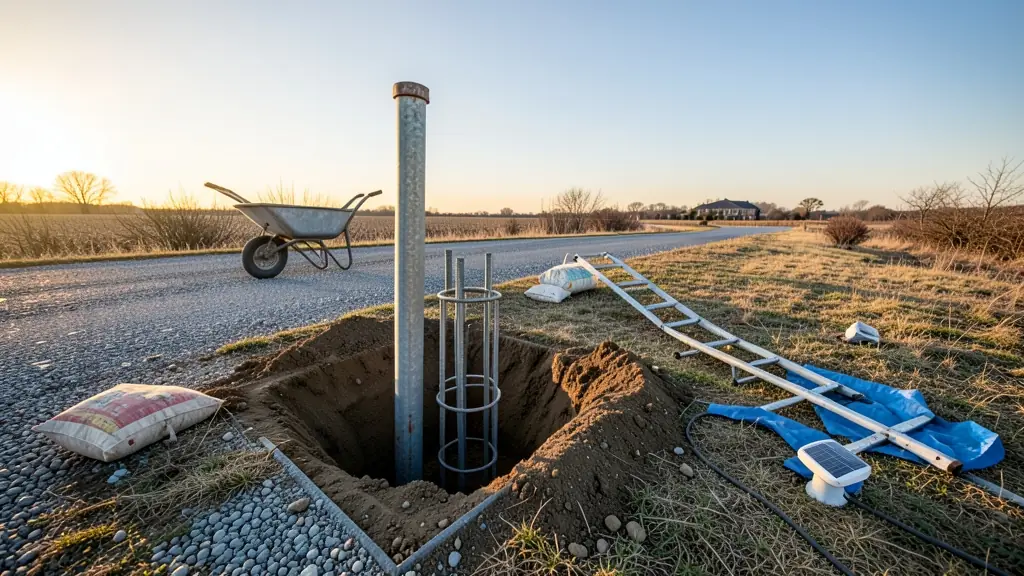
A pole is only as good as the hole it stands in. Contractors usually cast a concrete base with an anchor bolt cage, or plant the pole straight into concrete for shorter garden posts. Clay on the Highveld, sand near the coast and rock in the Karoo each change how deep and wide that base goes, so a site visit beats a guess. Poles in a road reserve or on a pavement need the municipality's permission first. For heights and spacing, see solar street lights and the street light spacing calculator.
On walls, use the bracket and anchors rated for the weight and the wind, not the plastic plugs in the box. Face brick, hollow block and a plastered wall all take different fixings.
Aiming and commissioning on the day
- Point the panel north, tilted to suit the winter sun, clear of trees and eaves from mid morning to mid afternoon.
- Aim the head at the area to light, not into a neighbour's bedroom or at drivers on the road.
- Set the mode: dusk to dawn, dimmed with a motion boost, or a timer profile.
- Check that each light switches on at dusk, and test the sensor by walking past.
- Leave a list of what went where, with the remote and any spare parts.
What a full quote should include
The lights, poles or brackets, foundations, labour, equipment hire for height, travel, rubble removal and VAT, each on its own line. Ask what happens if a head fails in the first year: does someone come back up the pole, and who pays for it? Compare the whole job against trenching cable with the solar vs wired cost calculator, and read solar lighting for estates if a body corporate is buying.
What to put in your request
- What you are installing and how many
- Mounting surface: brick, block, timber or pole
- The height of the highest light
- Whether poles and foundations are part of the job
- Photos of the site and where the sun falls in winter
Solar Light Installation: who asks for them and why
- Homeowners and tenants: floods on the eaves, wall lights at the gate and a lamp post set in the garden
- Estates, complexes and body corporates: a contractor casting bases and planting poles along a complex's internal roads
- Farms, smallholdings and lodges: floods on shed walls and poles at the kraal with no cable run from the house
- Shops, guesthouses, churches and offices: car park heads and entrance lights fitted after hours so the shop stays open
- Municipalities and public contractors: poles planted along a ward's streets to the council's layout and with its permission
- Schools, clinics and sports clubs: walkway and field edge lights fitted in the holidays, out of reach of learners
- Mines, depots, yards and sites: temporary poles on a laydown yard that can be lifted and moved as the site grows
- Venues, events and campsites: festoon poles and pathway lights set up on a venue lawn and taken down after