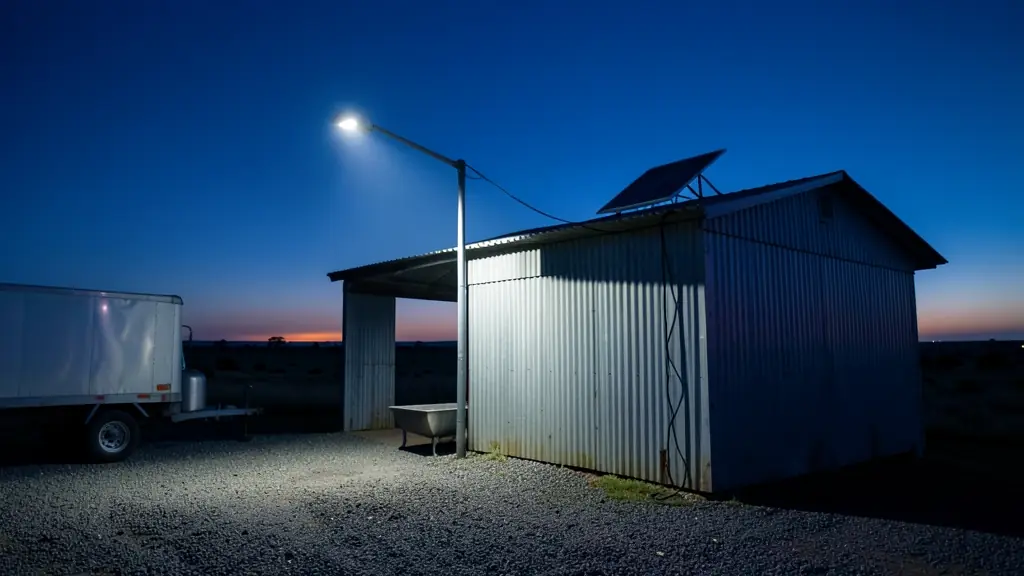
Solar flood lights are the most bought and most returned solar fitting in the country. The reason is printed on the box: a number like 200W or 500W that has nothing to do with the LED inside. A good flood lights a farm yard, a church car park or a side lane for most of the night. A bad one is bright until nine and then a glow. Here is how to tell them apart, which layout to pick and how to aim it so the light lands where you need it.
The fake watts on the box
Open a cheap "200W" flood and you will often find an LED board drawing 10 to 20 W and a battery the size of two fingers. The number is a marketing figure, not a measurement. Ask the supplier three things instead:
- Lumens, measured, not "equivalent".
- Battery in Wh, or mAh with the voltage (3.2 V LiFePO4 or 3.7 V lithium ion).
- Panel watts and size in cm.
A flood that runs 1,500 lm for ten hours needs roughly 100 to 150 Wh of battery once you allow for a cloudy day. If the battery is a tenth of that, the maths cannot work.
Separate panel on a cable, or all in one
An all in one flood has the panel on its back, so it only charges where the light hangs. That suits a pole in open ground. Under an eave, on a south facing wall or beside a big tree, pick a head whose panel sits apart on its own cable, usually 3 to 5 m long: mount the panel on the roof facing north and the head where the light is needed. Ask for a cable gland, not a plug that sits in the rain.
Remote modes and how long the night lasts
Most floods come with a small remote: full on, timer, dim, and motion. Full output all night drains the battery fastest. "Dim then bright on motion" gives a yard a low glow and full light when a bakkie comes in, and it can triple the hours. Check that the light remembers its mode after a dark spell, because some reset to full. The battery runtime calculator shows the hours for each mode, and motion sensor lights explains the sensor itself.
Lumens per yard and aiming the head
- A side lane or small backyard: 800 to 1,500 lm.
- A farm yard, kraal or church car park: 2,000 to 3,000 lm a head, often two or three heads.
- A depot or laydown yard: several heads on poles.
Mount at 3 to 5 m and tilt the head down about 30 degrees, so the beam lands on the ground and not in the neighbour's bedroom or a driver's eyes. Two floods from different corners leave fewer shadows than one big one. Work out how many you need with the flood light coverage calculator, and see solar security lights for perimeter work.
What to put in your request
- Give the size of the area in metres
- Say which way the wall or pole faces
- Ask for measured lumens and battery Wh
- Say which mode you want: all night or motion
- Mention the mounting height and if you need a pole
Solar Flood Lights: who asks for them and why
- Homeowners and tenants: a flood over the driveway or backyard that keeps the property lit during load shedding
- Estates, complexes and body corporates: floods at the guard hut, refuse area and visitor parking with no new cable run
- Farms, smallholdings and lodges: yard, kraal and shed floods on a Karoo or Highveld farm far from the house supply
- Shops, guesthouses, churches and offices: car park and loading bay floods for a church, shop or guesthouse after closing
- Municipalities and public contractors: floods for taxi ranks, sports fields and community halls where theft of cable is common
- Schools, clinics and sports clubs: floods over the grounds, a netball court edge or a hostel entrance at night
- Mines, depots, yards and sites: laydown yard, perimeter and site camp floods for mines and construction contractors
- Venues, events and campsites: temporary floods for parking fields and setup areas at a farm wedding or festival