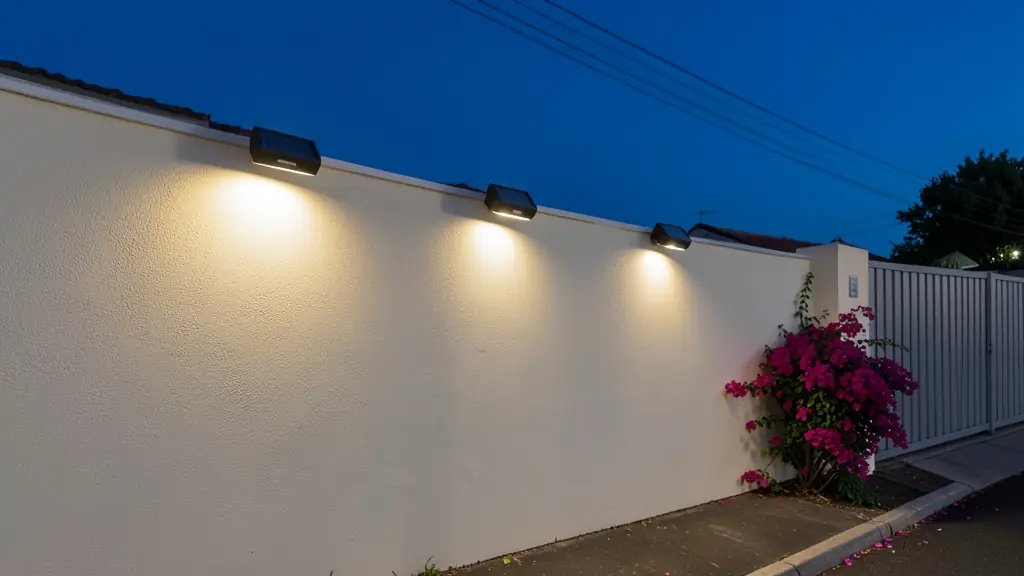
Outdoor solar wall lights go beside the front door, on the stoep, on gate pillars and along boundary walls. They are the easiest solar light to fit: two screws and a level. The hard part is the wall itself. A wall light charges where it hangs, so a wall that faces south or sits under a deep roof overhang will starve it. This page covers the kinds of wall light, how high to mount them, which walls work and what to do about the ones that do not.
Up and down, flush and pillar lights
- Up and down lights throw a beam both ways on the wall. They look good on a plastered boundary and give 100 to 300 lm, enough to mark the wall, not to light the pavement.
- Door and stoep lights of 300 to 800 lm light a lock, a step and a face at the gate. Many have a motion sensor.
- Pillar caps and pillar lights sit on or near gate pillars and mark the entrance. See solar driveway lights for the turn in.
- Floods on a wall are a different job: solar flood lights.
Which wall gets sun
In South Africa the sun sits in the north, and in winter it is low. A north facing wall is best, east and west walls are fair, and a south facing wall gets almost no direct sun from May to August. Look for the shadow of the eave, the neighbour's double storey or the jacaranda. A panel in shade at noon in June will not see the night through. Check your town with the winter sun hours tool.
A separate panel for a south wall
For a front door on the south side, buy a fitting whose panel is wired to it on a lead rather than built in. Mount the panel on the roof, the top of the boundary wall or a short pole facing north, and run the cable along the wall in a small conduit. Keep the cable run short, a few metres, and seal the entry with a grommet. This is often the only way a light under a deep veranda works in winter.
Mounting height and fixing
Mount door lights about 1.8 to 2.2 m up, so the light lands on the step and is out of easy reach. Boundary lights go 1.5 to 2 m apart on long walls. Use brick plugs and stainless screws on face brick and plaster; on a precast wall, use plugs made for hollow panels, or the light will be on the pavement by spring. Leave the battery hatch reachable so you can swap the cell later.
What to put in your request
- Say which way each wall faces
- Give the wall length for boundary lights
- Say if there is a roof overhang above
- Choose up and down, door or pillar lights
- Say if you want them fitted
Solar Wall Lights: who asks for them and why
- Homeowners and tenants: lights beside the front door, along the stoep and on the boundary wall by the gate
- Estates, complexes and body corporates: matching wall lights on unit entrances and along the complex boundary wall
- Farms, smallholdings and lodges: lights on the farmhouse back door, the store room and the workers' house walls
- Shops, guesthouses, churches and offices: entrance and signage wall lights for a shop, church hall or guesthouse
- Municipalities and public contractors: wall lights on community halls, clinics and public toilets without reliable supply
- Schools, clinics and sports clubs: classroom door and corridor wall lights for evening classes and hostels
- Mines, depots, yards and sites: wall lights on site offices, gate houses and store containers
- Venues, events and campsites: temporary wall lights on a venue's outbuildings and bathroom block