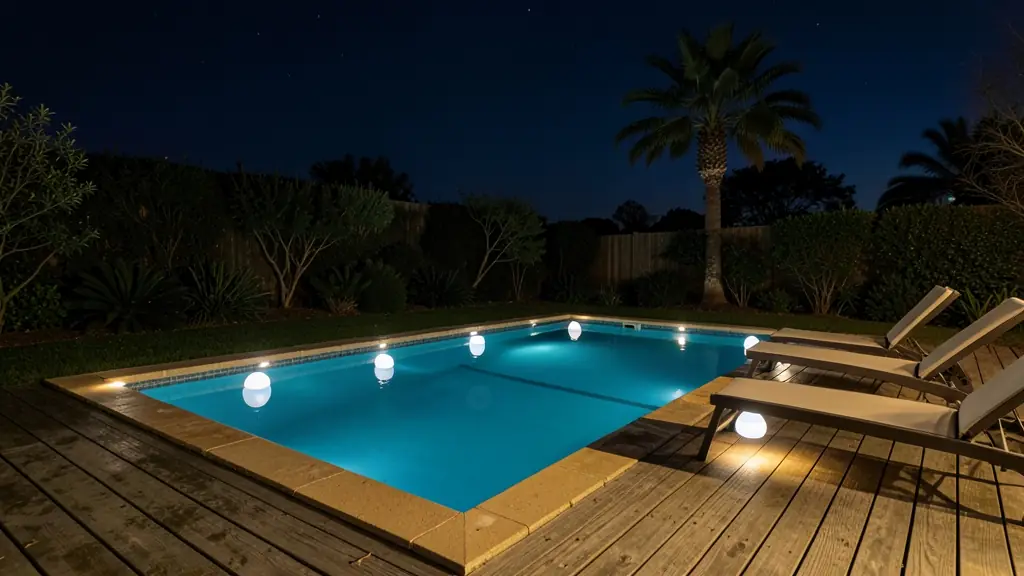
Solar pool lights give you light on and around the water without a single mains cable near the pool, which is the safest way to do it. The choice is floating balls and lily shapes that drift on the surface, small lights along the coping and steps, and lights on the deck or the fence around the pool. A family in Centurion wants the pool to look good on a December evening. A guesthouse in Ballito wants guests to see the steps. Both need lights that survive chlorine and hard sun.
Floating, coping, step or deck
- Floating lights. Balls, cubes and lily pads that charge on the water by day. Usually 20 to 80 lm each: mood light, not safety light.
- Coping and edge lights. Small round units glued or screwed into the pool surround, marking the edge.
- Step lights. Set into or beside the steps so people can see where they enter.
- Deck and fence lights. Wall lights or string lights on the pool fence or pergola light the area for safe walking.
IP68 for anything in the water
IP65 handles splashes and rain. IP67 survives a brief dunking. Anything that floats or sits in the pool all summer needs IP68, rated for continuous submersion. Even then the weak point is the charging port cover or the battery hatch seal. Check that the hatch has a proper rubber ring and screws, and dry it well before opening it. More on ratings under waterproof solar lights.
Chlorine, salt and sun on plastic
Pool water and Highveld UV are hard on plastic. Cheap clear shells yellow and go brittle in one or two summers, and the panel's lamination clouds over so the light charges less. Salt chlorinators and coastal air corrode steel screws. What helps:
- A UV stabilised shell and stainless steel or plastic screws.
- Taking floating lights out before shock dosing the pool.
- Rinsing them in fresh water now and then.
- Lifting them out over winter, when nobody swims and the sun is low anyway.
Colours, modes and a pool cover
Most floating lights cycle colours or hold one; pick a set that can be locked on warm white, since constant colour change gets tiring quickly. Floating lights must come out before a cover or safety net goes on, and they can clog the skimmer weir if they drift into it. Check the size against the skimmer opening. For lights that run all evening, see how runtime works in the battery runtime calculator.
What to put in your request
- Give the pool size and shape
- Say whether it is chlorine or salt water
- Count the steps and the length of coping
- Mention a pool cover or net
- Say whether you want colour or warm white only
Solar Pool Lights: who asks for them and why
- Homeowners and tenants: floating balls for summer evenings and coping lights so the edge is visible
- Estates, complexes and body corporates: the clubhouse pool's steps, surround and gate lit without cable near the water
- Farms, smallholdings and lodges: a farm dam deck or a reservoir pool lit for evening swims with no grid
- Shops, guesthouses, churches and offices: guesthouse and lodge pools where guests swim after dinner
- Municipalities and public contractors: public pool surrounds and splash park edges for evening events
- Schools, clinics and sports clubs: the school pool's steps and fence for evening galas
- Mines, depots, yards and sites: mine village and camp recreation pools where trenching is difficult
- Venues, events and campsites: floating lights on a pool for a wedding reception or a garden party