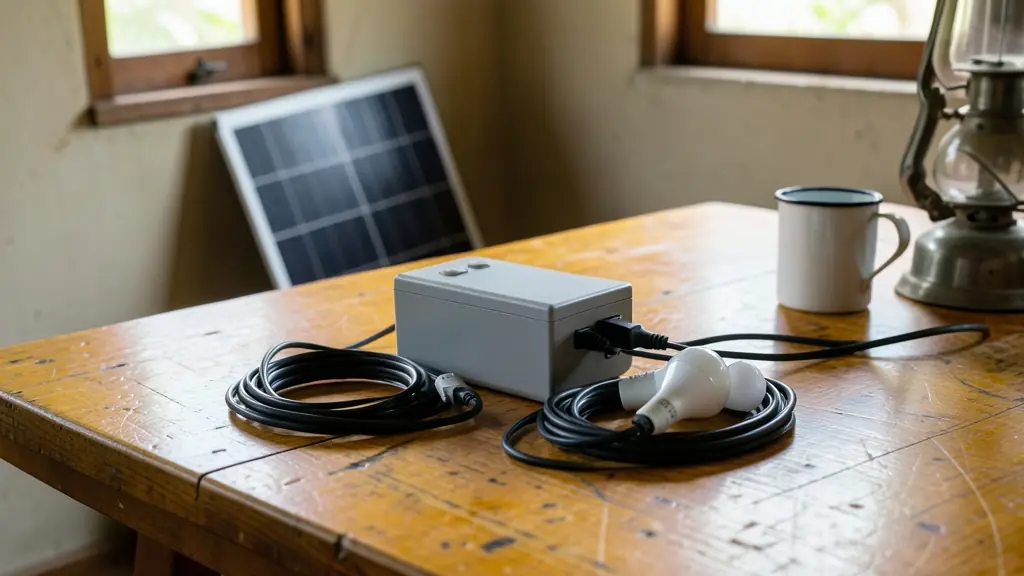
A solar lights system for the home is the small kit, not the big rooftop install: one panel, a battery box the size of a shoebox, two to four LED bulbs on long cables and a USB port for phones. It lights a kitchen and two bedrooms through load shedding, a Wendy house with no wiring, a farm worker's cottage or a holiday shack on the Wild Coast. It is cheap to run and simple to fit, but it is not an inverter system and will not run the kettle.
What is in the box
- The panel: usually 10 to 40 W, on a 5 m or longer cable so it can go on the roof while the box stays inside.
- The battery box: a lithium or LiFePO4 pack with a charge controller, switches and USB ports.
- The bulbs: two to four low voltage LED bulbs of 200 to 400 lm each, every one on its own cable with a switch.
- Extras: a phone cable with several tips, wall hooks and sometimes a small fan or a 12 V socket.
Kit, inverter or a few lights on cables
An inverter system with a big battery runs the fridge, TV and Wi-Fi off 230 V, and once it is tied into the house wiring the electrician who connects it has to issue a CoC for that work. A home kit runs on its own low voltage, plugs together by hand and touches nothing on the distribution board. If you only need one room lit, indoor solar lights with a panel outside may be enough. A kit sits between the two: several rooms and the phones, with no electrician involved.
What it can and cannot run
It runs LED bulbs, phone and tablet charging, a small radio and, on the bigger kits, a 12 V fan or a small TV built for solar. It cannot run a kettle, iron, hair dryer, heater, microwave or fridge: those draw hundreds to thousands of watts and would empty the pack in minutes. Do the sum: three 3 W bulbs for five hours is 45 Wh, two phone charges add about 30 Wh, so a 100 Wh pack covers a night with room for a grey day. Size yours with the solar light sizing calculator.
Setting it up properly
Put the panel facing north at a tilt, clear of chimneys and trees, and check it gets sun from ten until three in June. Run the cable through a window frame or a drilled hole sealed with silicone, not through a door that will pinch it. Keep the box indoors, away from the stove. Find your town's winter sun on winter sun hours.
What to put in your request
- How many rooms and bulbs you want lit
- Hours of light a night in winter
- How many phones or devices to charge
- Panel cable length from roof to box
- Delivery address or town
Solar Light System for Home: who asks for them and why
- Homeowners and tenants: the kitchen, lounge and two bedrooms lit through load shedding with phones charged
- Estates, complexes and body corporates: a gardener's or guard's room lit where the complex never ran a cable
- Farms, smallholdings and lodges: workers' cottages, a hunting camp or a shed with no grid within reach
- Shops, guesthouses, churches and offices: a small spaza, salon or tuck shop kept open after dark during power cuts
- Municipalities and public contractors: basic lighting for households in an informal settlement before electrification arrives
- Schools, clinics and sports clubs: a rural clinic's waiting room, a teacher's cottage or a hostel study room lit at night
- Mines, depots, yards and sites: a site office or guard room on a construction site before temporary power is connected
- Venues, events and campsites: a campsite ablution block, a bush camp tent or a festival crew room lit for a week