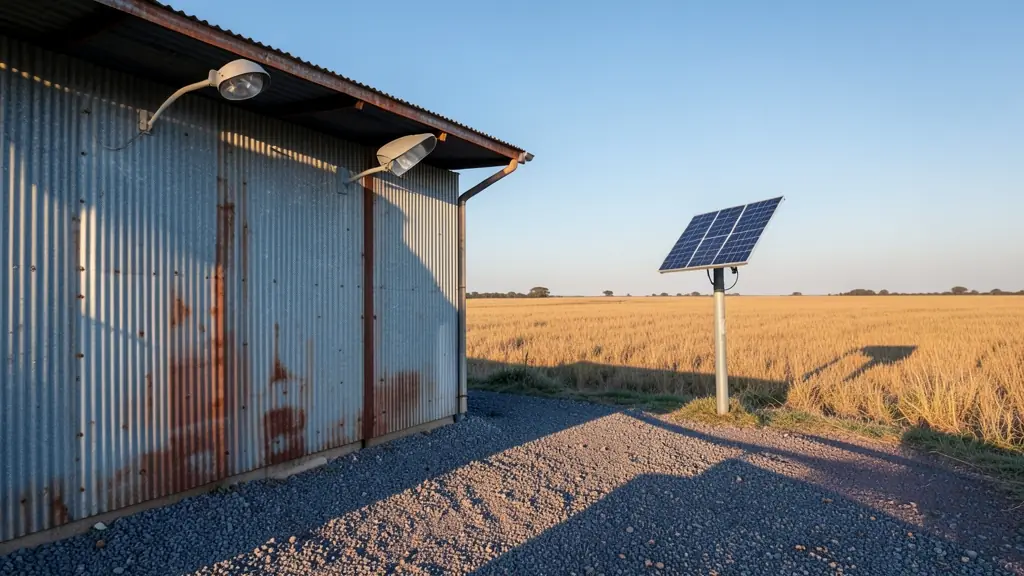
A solar light works when three numbers agree: the light it gives, the battery behind it and the panel that refills that battery on a short winter day. Boxes rarely state all three honestly. Type the lumens you need and the hours of light, pick your town, and this calculator gives the LED watts, the night's energy in Wh, the battery with a cloudy night in reserve and the panel for June sun. Compare it with what suppliers offer on solar lights and solar flood lights, or look up your town on winter sun hours.
From lumens to a night's energy
The tool divides the lumens by 100 lm per watt, the low end of what outdoor LED fittings reach in published tests, and adds 10% for the driver and controller. A 1,000 lm yard light comes to about 11 W at the battery. Run it for 12 hours and it uses about 132 Wh a night.
That assumes full output all night. If the light dims after midnight or waits for motion, the battery runtime calculator counts each part of the night on its own. A box that prints "300W" beside a 10 W LED is no help here: ask for lumens.
Battery: one dark night in reserve
The battery has to carry tonight and one more night after a grey day, so the tool doubles the night's Wh and divides by the share you can use without wearing the cells out: 80% of a lithium iron phosphate (LiFePO4) or lithium ion battery, 50% of sealed lead acid. The 132 Wh light needs about 330 Wh of LiFePO4. Street and estate heads get two spare nights instead of one.
To check a quote given in amp hours, divide Wh by the voltage: 330 Wh is about 26 Ah at 12.8 V, or 103 Ah at 3.2 V. A battery quoted in mAh with no voltage cannot be checked at all.
Panel: sized for the shortest days
The panel must put back a full night's energy on a June day. The tool takes your town's June peak sun hours from the European Commission's satellite records and keeps back 30% for heat, dust, a simple controller and a panel that is seldom perfectly aimed. A flat panel in Johannesburg sees about 4.0 sun hours in June, so 132 Wh needs about 47 W; in Cape Town, at 2.4, about 79 W.
Tilt the panel north at your latitude plus 15 degrees and the size drops by about a quarter in Johannesburg and 40% in Cape Town. A panel under an eave, behind a tree or facing south falls short whatever its size.
Sources
- European Commission JRC, PVGIS 5.3 monthly radiation tool (API MRcalc): queried per town on 2026-11-24 at the coordinates in SUN: radiation database PVGIS-SARAH3, 2014 to 2023, horizon from the terrain model; monthly global irradiation on a horizontal plane, at the annual optimum angle and at a fixed angle of latitude plus 15 degrees facing north (aspect 180); monthly kWh/m² divided by days in the month gives kWh/m²/day, the same number as peak sun hours
- European Commission JRC, PVGIS user manual: PVGIS-SARAH3 (satellite, 2005 to 2023) is the default database in PVGIS 5.3 for Africa; 'a default value of 14% for the overall losses' of a PV system; monthly global horizontal and optimal angle irradiation in kWh/m²
- US Department of Energy, SSL programme posting on the CALiPER snapshot of LED outdoor area lighting (October 2017): efficacy of listed outdoor area products from 'less than 70 to more than 150 lm/W'; 'mean efficacies for the three product categories are between 99 and 106 lm/W, with more than 30 products exceeding 150 lm/W'
- Battery education site, BU-205 types of lithium ion: LiFePO4: 3.20 or 3.30 V nominal, 2.5 to 3.65 V, 2,000 cycles or more, thermal runaway 270 °C, sensitive to heat; cobalt and nickel based (LCO, NMC, NCA, the usual 18650): 3.6 or 3.7 V, 3.0 to 4.2 V, 500 to 2,000 cycles, thermal runaway 150 to 210 °C
- Battery education site, BU-201 how the lead acid battery works: deep cycle lead acid: 150 to 200 cycles at 100% depth of discharge, 400 to 500 at 50%, 1,000 and more at 30%; 'every 8°C (15°F) rise' above 25 °C 'cuts battery life in half'; low charge causes sulfation, store it full
- Cell maker E, 26650 LiFePO4 3,200 mAh data sheet: 3.2 V; 3,200 mAh; charge to 3.65 V, cut off 2.5 V; 2,000 cycles at 100% depth of discharge to 80% capacity; charge 0 to 55 °C; discharge -20 to 60 °C; storage -20 to 45 °C
- Pack maker G, 12.8 V 9 Ah LiFePO4 pack data sheet: 4 cells in series (26650); 12.8 V, 9 Ah, 115.2 Wh; more than 2,000 cycles at 100% depth of discharge to 70%; charge 0 to 45 °C; discharge -20 to 60 °C; self discharge 3.5% a month or less; charge 14.6 V, cut off 10.0 V
- Battery maker H, 12 V 7 Ah sealed lead acid data sheet: 12 V 7 Ah; cycles: 250 at 100% depth of discharge, 550 at 50%, 1,200 at 30%; charge -15 to 50 °C; discharge -20 to 60 °C; 85% left after 6 months at 20 °C; standby life 3 to 5 years
Frequently asked questions
Why does my light's box claim far more than this?
Can I size for December instead?
What if the light must stay bright all night?
What happens after I send a request from this page?
More calculators
- Battery runtime calculatorHow many hours a battery runs a light, with dimming and motion mode
- Street light spacing calculatorRoad width and pole height to spacing, poles per 100 m and lumens
- Flood light coverage calculatorArea and use to target lux, lumens needed and how many floods
- Solar against wired cost calculatorTrench, cable and electrician against solar heads, with payback
- Winter sun hours by townPeak sun hours in June and December by town, and the panel angle
- Battery replacement finderPick the cell in your light: what replaces it, and what never to use