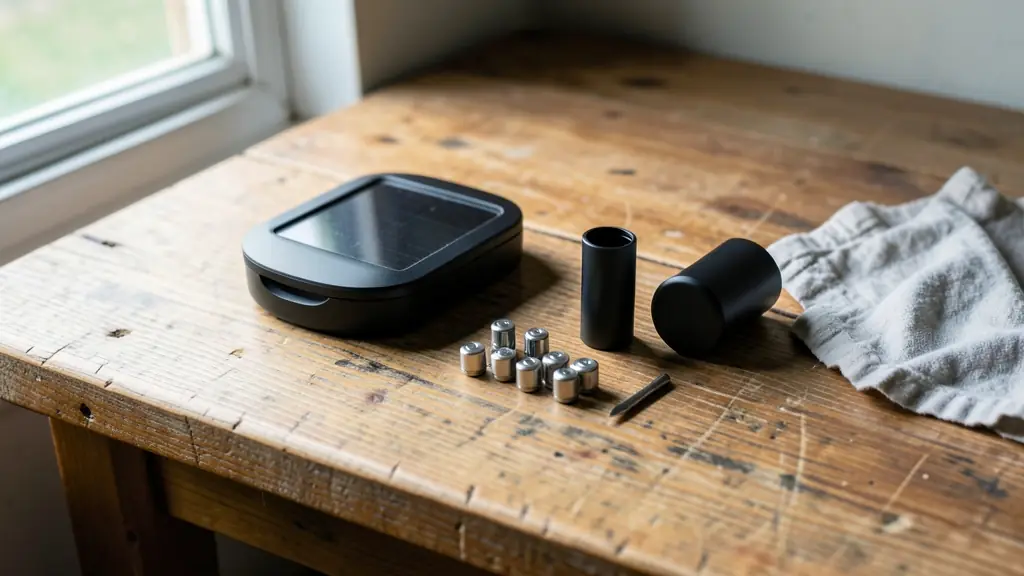
When a solar light fades after a winter or two, the battery is the usual cause and often the cheapest fix. The trick is matching it. Pick the cell or pack you find inside, and this finder shows the voltage the new one must keep, the capacity range makers publish, the cycle life, the temperatures it can charge in and the cells that must never take its place. Read the longer story on batteries for solar lights, check the fault first on solar light repairs, and see the safety side on solar light safety.
Voltage first, then size
Nearly every cell in a solar light belongs to one of three families: NiMH at 1.2 V, lithium ion at 3.6 to 3.7 V and lithium iron phosphate (LiFePO4) at 3.2 V. Packs of 6 V and 12 V are usually sealed lead acid, or 12.8 V LiFePO4 made of four cells. The replacement must have the same voltage and fit the holder; its capacity can match the old one or be higher.
Size codes give the shape: an 18650 is 18 mm across and 65 mm long, a 32650 is 32 mm by 65 mm. A 14500 is the size of an AA but holds a 3.2 V or 3.7 V lithium cell, so read the label, not the shape.
What never goes in
- Alkaline cells: they are not rechargeable. The light tries to charge them anyway, and they leak and corrode the contacts.
- A 3.7 V lithium ion cell in a 3.2 V light: at 4.2 V when full it can overdrive the LEDs and the controller, and it never charges properly.
- A 3.2 V LiFePO4 cell in a 3.7 V light: the light charges it towards 4.2 V, well past its 3.65 V limit.
- A cell with an impossible label: an 18650 marked 8,000 or 9,000 mAh. Data sheets for real ones stop near 3,500.
Bulging, hot or leaking cells go to a battery recycling drop off, not the bin.
Heat, cold and cycle life
AA NiMH cells are rated for 350 to 500 cycles, a year or so of nightly use, and ordinary ones lose 10 to 15% of their charge a month. Lithium ion 18650s are rated for about 300 to 500. LiFePO4 data sheets give 2,000 full cycles, five years and more, and the chemistry stays stable to a far higher temperature, which is why it suits a black light box in a Limpopo summer.
Most lithium cells must not charge below 0 °C, or above 45 to 60 °C depending on the data sheet. Lead acid loses half its life for every 8 °C above 25 °C.
Sources
- Battery education site, BU-205 types of lithium ion: LiFePO4: 3.20 or 3.30 V nominal, 2.5 to 3.65 V, 2,000 cycles or more, thermal runaway 270 °C, sensitive to heat; cobalt and nickel based (LCO, NMC, NCA, the usual 18650): 3.6 or 3.7 V, 3.0 to 4.2 V, 500 to 2,000 cycles, thermal runaway 150 to 210 °C
- Battery education site, BU-802b self discharge: nickel based (NiMH): 10 to 15% in the first 24 h, then 10 to 15% a month; Li-ion 5% in 24 h, then 1 to 2% a month plus about 3% for the protection circuit; lead acid about 5% a month
- Battery education site, BU-201 how the lead acid battery works: deep cycle lead acid: 150 to 200 cycles at 100% depth of discharge, 400 to 500 at 50%, 1,000 and more at 30%; 'every 8°C (15°F) rise' above 25 °C 'cuts battery life in half'; low charge causes sulfation, store it full
- Battery maker A, AA NiMH 800 mAh low self discharge data sheet: 1.2 V; 800 mAh; at least 500 cycles (IEC); at least 80% kept after 12 months at 20 °C; charge 0 to 45 °C; discharge -20 to 65 °C
- Battery maker A, AA NiMH 2100 mAh low self discharge data sheet: 1.2 V; 2,100 mAh nominal, 1,900 minimum; at least 500 cycles (IEC); 80% after 12 months; charge 0 to 45 °C; discharge -20 to 55 °C
- Distributor house brand, AAA NiMH 900 mAh low self discharge data sheet: 1.2 V; 950 mAh typical, 900 minimum; 350 cycles (IEC 61951-2); about 70% left after a year at 20 °C; charge 0 to 45 °C; discharge -10 to 65 °C
- Cell maker B, 18650 Li-ion 3,350 mAh data sheet: 3.6 V nominal; 3,200 mAh rated, 3,350 typical; charge 0 to 45 °C (below 10 °C at a reduced rate); discharge -20 to 60 °C
- Cell maker C, 18650 Li-ion 3,350 mAh data sheet: 3.6 V; 3,350 mAh nominal, 3,250 minimum; 4.20 V charge, 2.50 V cut off; charge 0 to 45 °C; discharge -20 to 60 °C; store a year at -20 to 25 °C
- Cell maker E, 26650 LiFePO4 3,200 mAh data sheet: 3.2 V; 3,200 mAh; charge to 3.65 V, cut off 2.5 V; 2,000 cycles at 100% depth of discharge to 80% capacity; charge 0 to 55 °C; discharge -20 to 60 °C; storage -20 to 45 °C
- Cell maker F, 32650 LiFePO4 6,000 mAh specification: 3.2 V; 6,000 mAh; charge 3.65 V at 0 to 60 °C; discharge -10 to 60 °C; cut off 2.0 V; 2,000 full cycles (to at least 80%); store a year at -20 to 25 °C
- Electronics retailer, 32650 LiFePO4 cell tested data sheet: marked 5,000 mAh; measured 3,700 to 4,700 mAh at 1C or less; 3.2 V nominal, 3.65 V max charge, 2.5 V recommended cut off; no maker's data sheet exists for the generic cell
- Pack maker G, 12.8 V 9 Ah LiFePO4 pack data sheet: 4 cells in series (26650); 12.8 V, 9 Ah, 115.2 Wh; more than 2,000 cycles at 100% depth of discharge to 70%; charge 0 to 45 °C; discharge -20 to 60 °C; self discharge 3.5% a month or less; charge 14.6 V, cut off 10.0 V
- Battery maker H, 12 V 7 Ah sealed lead acid data sheet: 12 V 7 Ah; cycles: 250 at 100% depth of discharge, 550 at 50%, 1,200 at 30%; charge -15 to 50 °C; discharge -20 to 60 °C; 85% left after 6 months at 20 °C; standby life 3 to 5 years
- Battery maker J, AA alkaline product specification: marked non rechargeable; 1.5 V nominal; about 3,000 mAh at a light load
- National DIY and hardware chain, online shop, rechargeable cells: VAT n/s: 4 pack AA 600 mAh NiMH R87.40 (R21.85 a cell)
- National electronics components retailer, online shop, rechargeable cells: product page shows ex VAT and inc VAT (LC18650-HT: R82.61 ex VAT, R95.00 inc VAT): 18650 2,600 mAh R95 inc, 18650 2,500 mAh R110 inc, 18650 2,200 mAh R201.25 inc; 26650 5,000 mAh Li-ion R258.75 inc; NiMH AA 2,100 mAh 4 pack R201.25 inc (R50.31 a cell), AA 2,000 mAh 4 pack R212.75 inc (R53.19 a cell), AA 2,100 mAh 2 pack R120.75 inc (R60.38 a cell); NiMH AAA 1,000 mAh tagged cell R40.25 inc, AAA 800 mAh 4 pack R174.80 inc (R43.70 a cell), AAA 700 mAh 4 pack R207 inc (R51.75 a cell); 12.8 V 7 Ah LiFePO4 R680 inc
- National online lighting shop (since 2009), batteries: VAT n/s: NiMH AA 2 pack R237 (R118.50 a cell); NiMH AAA 2 pack R127 (R63.50 a cell); 3.7 V lithium solar light battery R147 (button contact) and R227 (2,200 mAh)
Frequently asked questions
Can I put a higher mAh cell in my garden light?
Are low self discharge NiMH cells worth it?
How do I know which cell is inside?
What happens after I send a request from this page?
More calculators
- Solar light sizing calculatorLumens and hours in, LED watts, battery Wh and panel W out
- Battery runtime calculatorHow many hours a battery runs a light, with dimming and motion mode
- Street light spacing calculatorRoad width and pole height to spacing, poles per 100 m and lumens
- Flood light coverage calculatorArea and use to target lux, lumens needed and how many floods
- Solar against wired cost calculatorTrench, cable and electrician against solar heads, with payback
- Winter sun hours by townPeak sun hours in June and December by town, and the panel angle