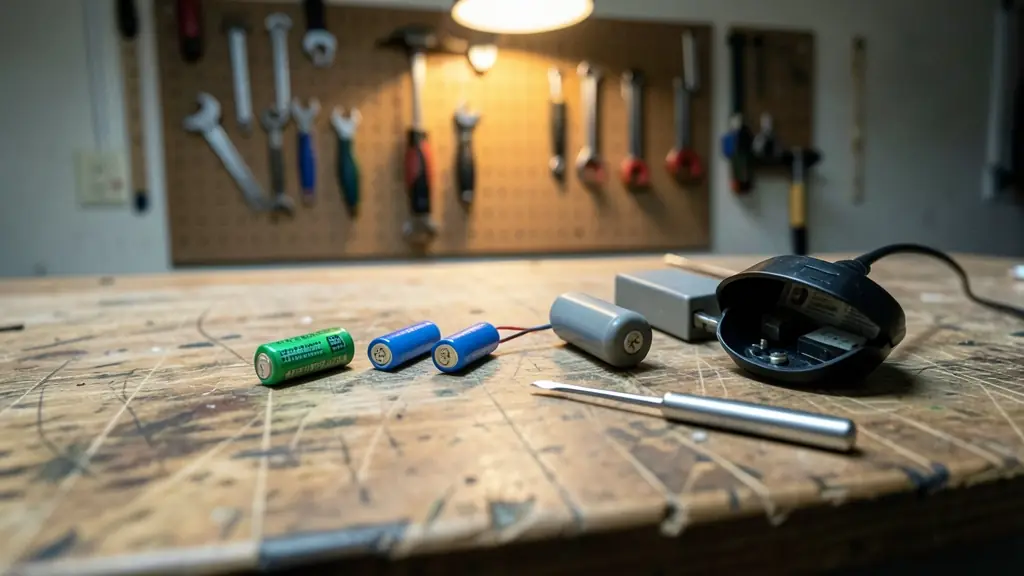
Most solar lights that go dim by July are not broken. Their battery has worn out, or it was too small from the start. Batteries for solar lights come in a handful of sizes and three chemistries, and the right replacement brings a light back to life for a fraction of a new one. The wrong one, an alkaline cell or a lithium cell in a slot made for NiMH, can kill the controller or leak acid into the housing.
The cells you will find inside
- NiMH AA and AAA, 1.2 V: garden stakes, string lights and small wall lights. Typically 600 to 2,000 mAh.
- 18650 lithium ion, 3.7 V: wall lights, motion lights and small floods. About 1,500 to 3,000 mAh.
- 26650 lithium ion, 3.7 V: a fatter cell for bigger floods, roughly 4,000 to 5,000 mAh.
- 32650 LiFePO4, 3.2 V: better floods and pole lights, about 5,000 to 6,000 mAh.
- Prismatic LiFePO4 packs, 12.8 V and up: flat blocks in street heads and split systems, rated in Wh.
Use the battery replacement finder to match what is in your light.
Match the voltage, then the size
Voltage first: a 1.2 V NiMH slot cannot take a 3.7 V lithium cell even if it fits, and a 3.7 V lithium ion controller may not charge a 3.2 V LiFePO4 cell fully. Then size, then capacity. A higher mAh at the same voltage is usually fine and gives longer nights, as long as the panel can fill it on a short winter day. Check for a solder tab or a small protection board on the old cell; if it has wires, the new one needs the same.
Why alkaline cells never go in
An alkaline AA is not rechargeable. The panel keeps pushing current into it every day, it swells, and within weeks it leaks a white crust that eats the springs and the circuit board. The same goes for zinc carbon cells. Only rechargeable NiMH, lithium ion or LiFePO4 belongs in a solar light. Old NiCd cells still turn up in very old lights; replace them with NiMH of the same size. Safe handling is covered on solar light safety.
How many years, and where they go after
As a rough guide, NiMH lasts one to two years in a garden light, cheap lithium ion two to three, and LiFePO4 five to eight, because it handles the heat inside a black housing on a Northern Cape wall far better. Dead cells do not go in the bin: many hardware stores, electronics shops and municipal drop off points take used batteries for recycling. Tape the ends of lithium cells before you drop them off.
What to put in your request
- Size printed on the old cell (AA, 18650)
- Voltage and mAh from the label
- Whether it has wires or solder tabs
- How many cells you need
- A photo of the cell and the light
Solar Light Batteries: who asks for them and why
- Homeowners and tenants: fresh AA cells in the garden stakes and an 18650 in the stoep light before winter
- Estates, complexes and body corporates: a batch of replacement packs for road and perimeter heads when the first ones fade
- Farms, smallholdings and lodges: new LiFePO4 cells for yard floods and kraal lights that sit in the summer heat
- Shops, guesthouses, churches and offices: cells for a guesthouse's path and patio lights swapped in one visit before the season
- Municipalities and public contractors: replacement 12.8 V packs for solar street heads under a maintenance contract
- Schools, clinics and sports clubs: cells for walkway and hostel lights changed in the holidays when no one is on site
- Mines, depots, yards and sites: battery packs for perimeter and laydown yard lights on a mine or depot
- Venues, events and campsites: fresh cells in a set of hired lanterns and festoons before the wedding season starts