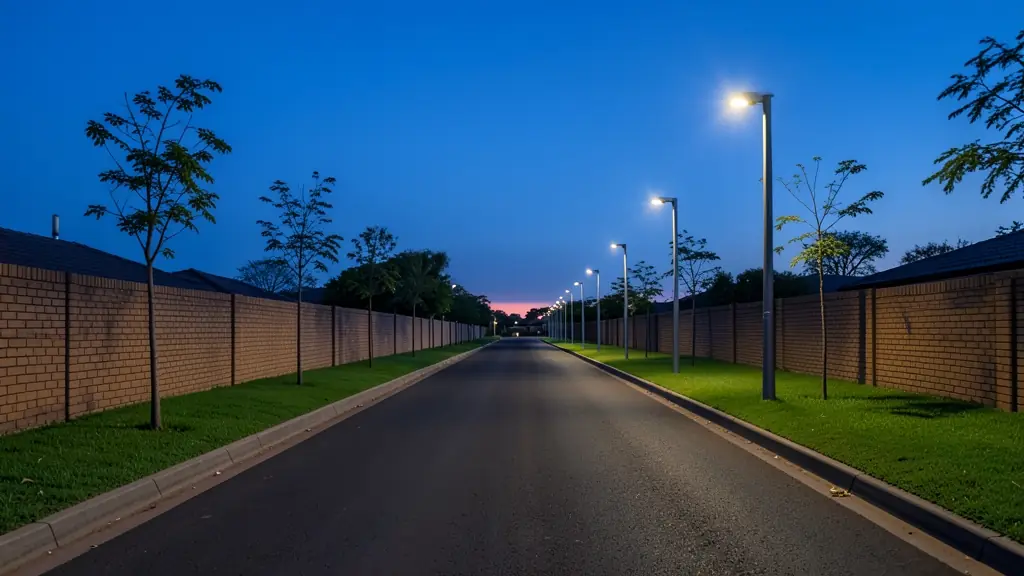
The gap between street lights decides both the bill and whether the road has dark patches between poles. Pick the kind of road, its width and a pole height, and this calculator gives the spacing, the number of poles for your length on one or both sides, and the lumens each head must put out. It suits a body corporate planning an estate road, a farm with a long access road or a contractor checking a tender count. Read more on solar street lights and solar lighting for estates, and weigh the cost with solar against wired.
Pole height sets the spacing
The usual rule puts poles three to four times their height apart. The tool uses 4 for paths, driveways and farm roads, 3.5 for estate roads, streets, car parks and perimeters, and 3 for a main road. A 5 m pole on an estate road gives about 17.5 m, so roughly six poles per 100 m on one side.
Taller poles cover more ground, but each costs more, needs a deeper foundation and puts the head higher out of a thief's reach. Bends, junctions, speed humps and gates need a pole of their own whatever the sum says.
Lumens per head from the light level
Each road type carries a target average light level taken from published lighting tables: 5 lux for a walkway or a quiet estate road, 3 for a farm road, 7.5 for a residential street and 10 for a car park or a perimeter. The tool multiplies the lux by the patch each pole lights (spacing x width), then divides by 0.8 for dirt and ageing and by 0.5 for light that misses the road.
On a 6 m estate road with 17.5 m spacing that comes to about 1,300 lm a head. Heads in the usual 2,000 to 8,000 lm range leave room to dim after midnight.
What the tool cannot decide
A public road belongs to the municipality, which sets its own street lighting spec under the national road lighting code and must approve any pole in the road reserve. Treat these numbers as a first count for a quote, not a design: a lighting engineer checks evenness, glare and dark spots with software.
On a private estate the body corporate decides. Ask each supplier for a layout drawing, the battery autonomy in nights and how the heads and panels are fixed against theft.
Sources
- Luminaire maker, access roads, car park and building perimeter application page (table after CIBSE SLL Lighting Guide 1): minimum maintained average lux and uniformity: pedestrian walkways 5 (0.25); slow vehicles up to 10 km/h 10 (0.40); regular traffic up to 40 km/h 20 (0.40); loading points 50 (0.40); security very low risk 5, low 10, medium 20, high 50; car parks light traffic low crime 5, medium traffic medium crime 10, heavy traffic medium crime 20 (0.25)
- Fotios and Robbins (2020), Research note: describing average illuminance for P-class roads, Lighting Research and Technology 52(8): Table 1, subsidiary (residential) road classes in BS 5489-1:2013, average and minimum lux: P1 15 and 3, P2 10 and 2, P3 7.5 and 1.5, P4 5 and 1, P5 3 and 0.6, P6 2 and 0.4
- Texas Department of Transportation, highway illumination manual: illumination levels: cross check: residential local road 0.4 fc average (about 4.3 lux), collector 0.6 fc (6.5 lux), major 0.8 fc (8.6 lux); 'the proper light loss factor (LLF) should be used in all lighting calculations'
- Illuminating Engineering Society of South Africa, lighting for roads and precincts in South Africa: SANS 10098-1 road groups: A (major roads, luminance), B1 to B3 (residential streets, horizontal illuminance), C1 to C2 (wholly pedestrian, semi cylindrical illuminance); maintenance factor 'typically ranging from 0.7 to 0.9' (ARP 035); no lux values given
- Navy construction electrician training manual, exterior floodlighting design: maintenance factor where no maker data: enclosed floodlights 0.76, open 0.65; worked example coefficient of utilisation 0.38 for a large area lit from two heights
Frequently asked questions
One side of the road or both?
Can I use the poles I already have?
Why does a main road show such a high lux figure?
What happens after I send a request from this page?
More calculators
- Solar light sizing calculatorLumens and hours in, LED watts, battery Wh and panel W out
- Battery runtime calculatorHow many hours a battery runs a light, with dimming and motion mode
- Flood light coverage calculatorArea and use to target lux, lumens needed and how many floods
- Solar against wired cost calculatorTrench, cable and electrician against solar heads, with payback
- Winter sun hours by townPeak sun hours in June and December by town, and the panel angle
- Battery replacement finderPick the cell in your light: what replaces it, and what never to use