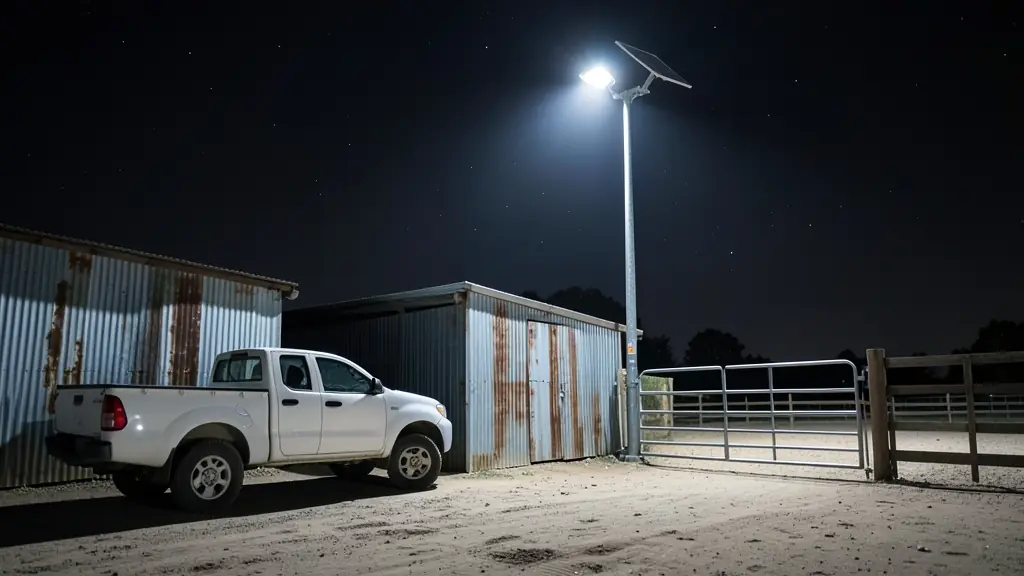
How many flood lights does a yard need? The honest answer starts with the area and what happens in it, not the wattage on the box. Type the size in metres and choose security, yard, parking or sports. The calculator takes a light level from published lighting tables, allows for light lost to dust and to spill past the edges, and tells you how many floods of a given output cover the space. Read about separate panels and remote modes on solar flood lights and solar security lights, then size each flood's battery with the sizing calculator.
Light levels by use
The targets come from published exterior lighting tables. A walkway or a quiet car park gets 5 lux, a low risk security area or a yard with slow vehicles 10, a medium risk site 20 and a loading bay 50. Football training is listed at 75 lux and tennis training at 200.
Solar handles the lower levels well. From about 50 lux up, the floods, batteries and panels grow large and costly, and a sports field usually ends up wired to the mains or on a generator. Run both options before you choose.
From lux to lumens
Lumens needed = lux x area / (0.8 x 0.5). The 0.8 covers dust on the cover and LEDs that fade with age; the 0.5 covers light that lands outside the area or on walls. A 20 x 15 m yard at 10 lux needs about 7,500 lm: three floods of 2,500 lm or four of 2,000.
Change the 0.5 if you know the site. A flood aimed tightly into a small corner wastes less; a wide field lit from one side wastes more.
Placing the floods
Mount yard floods high, about 4 to 6 m, and aim them down and across rather than out at the road, where they dazzle drivers and the neighbours. Two floods from different corners throw fewer shadows than one big one. If a flood hangs under an eave, put its panel on its own bracket in full sun.
For security, light the approach and the gate rather than the wall of the house, and use a motion mode so the battery lasts the long June nights.
Sources
- Luminaire maker, access roads, car park and building perimeter application page (table after CIBSE SLL Lighting Guide 1): minimum maintained average lux and uniformity: pedestrian walkways 5 (0.25); slow vehicles up to 10 km/h 10 (0.40); regular traffic up to 40 km/h 20 (0.40); loading points 50 (0.40); security very low risk 5, low 10, medium 20, high 50; car parks light traffic low crime 5, medium traffic medium crime 10, heavy traffic medium crime 20 (0.25)
- Luminaire maker, knowledge hub: safe lighting for outdoor car parks: quiet car parks at shops and homes: 'recommended average illuminance in such spaces is 5lux with 0.25 uniformity'; no standard named
- Electrical trade news, recreational sports lighting design: European class III (training): 75 lux for football, 200 lux for outdoor tennis; football 500 lux for an official match; uniformity at least 0.5 for recreational play
- Illuminating Engineering Society of South Africa, lighting for roads and precincts in South Africa: SANS 10098-1 road groups: A (major roads, luminance), B1 to B3 (residential streets, horizontal illuminance), C1 to C2 (wholly pedestrian, semi cylindrical illuminance); maintenance factor 'typically ranging from 0.7 to 0.9' (ARP 035); no lux values given
- Navy construction electrician training manual, exterior floodlighting design: maintenance factor where no maker data: enclosed floodlights 0.76, open 0.65; worked example coefficient of utilisation 0.38 for a large area lit from two heights
- US Department of Energy, SSL programme posting on the CALiPER snapshot of LED outdoor area lighting (October 2017): efficacy of listed outdoor area products from 'less than 70 to more than 150 lm/W'; 'mean efficacies for the three product categories are between 99 and 106 lm/W, with more than 30 products exceeding 150 lm/W'
Frequently asked questions
My flood says 300 W. How many lumens is that?
Is more lux always safer?
Can solar floods light a sports field?
What happens after I send a request from this page?
More calculators
- Solar light sizing calculatorLumens and hours in, LED watts, battery Wh and panel W out
- Battery runtime calculatorHow many hours a battery runs a light, with dimming and motion mode
- Street light spacing calculatorRoad width and pole height to spacing, poles per 100 m and lumens
- Solar against wired cost calculatorTrench, cable and electrician against solar heads, with payback
- Winter sun hours by townPeak sun hours in June and December by town, and the panel angle
- Battery replacement finderPick the cell in your light: what replaces it, and what never to use