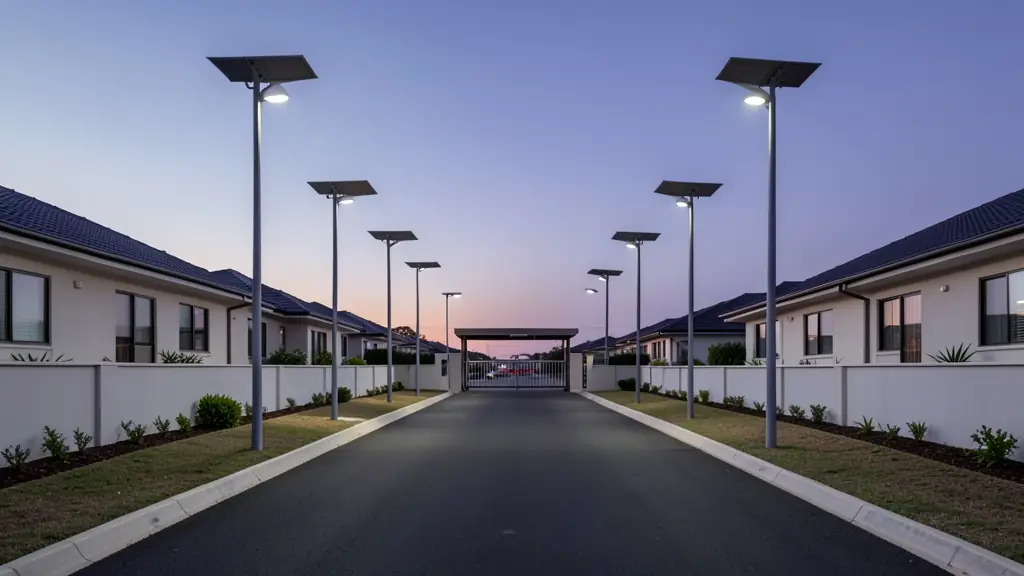
When a body corporate looks at solar street lights in South Africa, it is usually because the old mains lights on the internal road went dark in load shedding, the cable was stolen, or the trench quote for a new phase was more than the levy could carry. Estates, complexes, HOAs and farms buy differently from a homeowner: they need a lighting plan, a site visit, quotes that can be compared line by line, and someone to look after the lights for years.
What gets lit on an estate
- Internal roads: poles of 4 to 6 m, spaced roughly 3 to 4 times their height, so 15 to 24 m apart.
- The perimeter: lights along the inside of the wall or fence, often with a motion boost so the battery lasts.
- Gate and guard hut: the brightest point on the site, where faces and number plates must be seen.
- Parking and common areas: visitor bays, the clubhouse, the pool path and the bin yard.
Work out pole counts with the street light spacing calculator before the first meeting.
From trustee meeting to signed order
- A lighting plan: a site map with every road, path and dark spot marked, plus the hours of light wanted.
- A site visit: the supplier checks trees, roof shade on the panels and where the old poles stand.
- Tender style quotes: the same scope sent to three or more firms, priced per pole with heads, foundations and installation listed apart.
- A sample pole: one light up for a month before the full order, ideally through a winter week.
- Approval: trustees or the HOA sign off against the levy budget or a special levy.
Specs to put in the scope
Ask every bidder for the real lumens of the head, the battery in Wh and its chemistry (LiFePO4 lasts far longer in a hot pole top), the panel size, and how many dark days it runs without sun. Three is a fair ask for an estate road. Ask for dimming through the night, an IP66 head, pole wall thickness and bolt cages for the foundation. Any pole outside the estate wall, in the road reserve, needs the council's permission first, and where the council takes over the road later it may insist on its own lighting spec. Compare these numbers on solar street lights.
Maintenance is part of the price
Panels on an estate road collect dust, bird droppings and leaves from the jacarandas. Batteries wear out after five to eight years for LiFePO4, sooner for cheap lithium ion. A maintenance contract covers a yearly panel wash, a check of every head, replacing failed units and a fault report you can show the AGM. For the fitting itself, see solar light installation.
What to put in your request
- A site map with roads and dark spots marked
- Total road length in metres
- Pole height wanted, or ask for advice
- Hours of light a night and dimming
- Whether a maintenance contract is wanted
Solar Lighting for Estates: who asks for them and why
- Homeowners and tenants: a homeowner on the trustee committee gathering the facts before the next levy vote
- Estates, complexes and body corporates: internal roads, the perimeter wall, visitor parking and the clubhouse lit off grid
- Farms, smallholdings and lodges: the road from the farm gate to the workers' houses and the sheds without a cable run
- Shops, guesthouses, churches and offices: an office park or shopping centre lighting its internal roads and staff parking
- Municipalities and public contractors: a contractor pricing a new housing project where the developer lights the internal roads
- Schools, clinics and sports clubs: a boarding school lighting the road between hostels, the gate and the staff houses
- Mines, depots, yards and sites: a business park or mine village lighting its roads, gates and bus stop shelters
- Venues, events and campsites: a wedding venue or lodge lighting the road from the gate to the chapel and the cottages