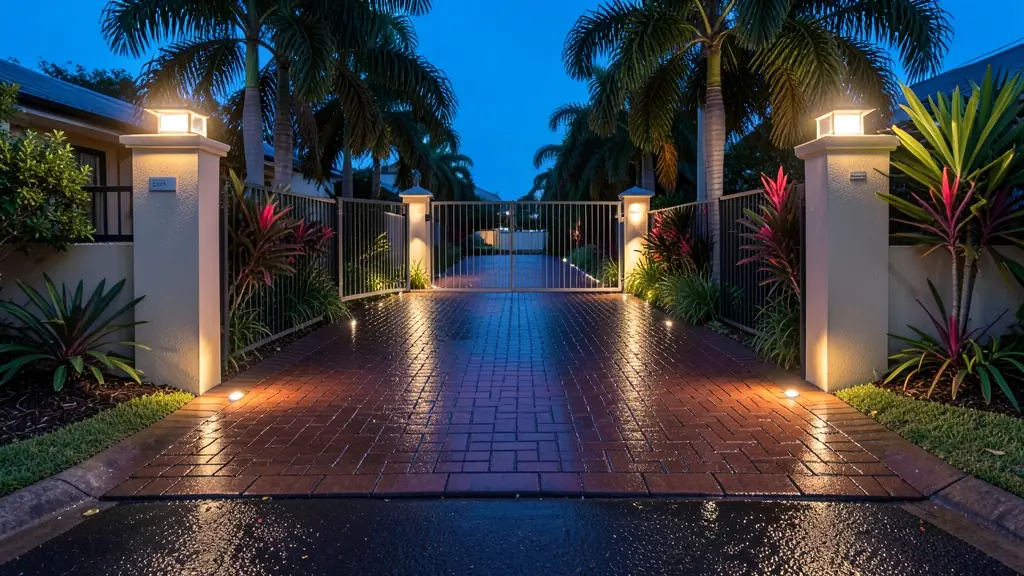
Solar driveway lights show you where the paving ends when you turn in from a dark street, and they keep doing it while the suburb sits through load shedding. A Randburg homeowner wants the turn in and the gate pillars lit. A farmer outside Bothaville wants a 600 m gravel road marked so visitors do not end up in the ditch. Both need lights that survive tyres, rain and garden services, not the cheap stake lights that fall over in a week.
Three kinds of driveway light
- Edge markers. Low lights on a short post or spike beside the paving. They show the line of the drive at 50 to 150 lm each and cost the least. Keep them out of reach of reversing tyres.
- Drive over lights. Round units set flush into paving or concrete with a toughened top. These must carry a car's weight and sit in water after a storm, so ask for the load rating and IP67 or better.
- Pillar caps and gate lights. Square or lantern tops on brick pillars, or wall lights on the gate posts, at 300 to 800 lm. Pillar ideas also on solar pole lights.
Spacing and the turn in from the street
The turn in matters most: it is where you swing across the pavement and where kerbs and pillars get clipped. Put the brightest light on the pillars and two markers close together at the mouth of the drive. Up the drive, markers every 2 to 4 m on curves and 4 to 6 m on straight stretches are plenty. Alternate the two sides on a narrow drive instead of lining both. Garden markers for beds and paths are covered under solar garden lights.
Recessed lights in the real world
Flush lights get the hardest life of any solar light. Mud, leaves and tyre dust cover the panel, so a recessed unit in the shade of a carport will barely charge. Mistakes we see:
- Setting units in a low spot where stormwater pools.
- Cutting into paving without a sand and gravel bed for drainage.
- Fitting them where a gate motor's track or a heavy truck passes.
If your drive is under trees, choose a post marker you can wipe clean instead.
Long farm driveways and gate motors
On a farm road of several hundred metres, short reflector posts plus a solar light every 30 to 50 m and a brighter one at each bend work better than a continuous line. At the gate, a solar light is not the same as powering a gate motor: the motor needs its own panel, battery and charger from the gate supplier. If you want poles along the road, the street light spacing calculator gives a pole count per 100 m.
What to put in your request
- Give the driveway length and width
- Say whether it is paving, concrete or gravel
- Count the gate pillars and their top size
- Mention trees or a carport that shade the drive
- Say whether you want flush lights a car can cross
Solar Driveway Lights: who asks for them and why
- Homeowners and tenants: the turn in from the street, the gate pillars and the curve up to the garage
- Estates, complexes and body corporates: edges of internal roads, speed humps and the visitor entrance lane at the boom
- Farms, smallholdings and lodges: a long gravel road from the tar to the house with brighter lights at each bend
- Shops, guesthouses, churches and offices: the entrance of a guesthouse or a church drive used for evening services
- Municipalities and public contractors: traffic island edges and park entrances where vehicles turn in after dark
- Schools, clinics and sports clubs: the drop off loop and the staff parking entrance used on winter evenings
- Mines, depots, yards and sites: internal haul road edges and the turn into a depot gate at shift change
- Venues, events and campsites: the access road to a wedding venue marked for guests leaving late