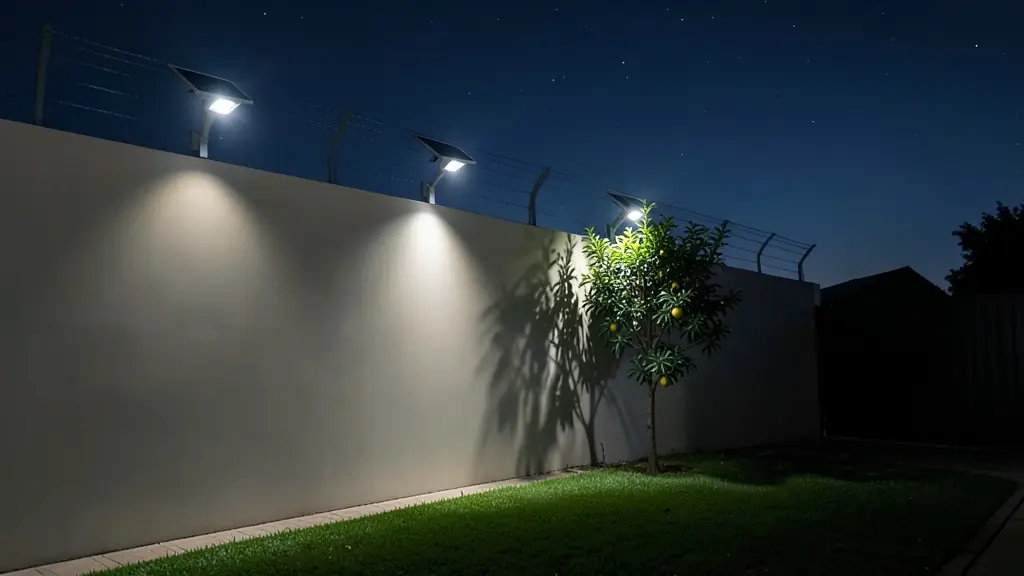
Most break ins start at the part of the property nobody sees from the lounge: the side passage, the corner behind the Wendy house, the gate the gardener uses. Solar security lights put light on those spots without a trench or an electrician, and they keep working when the area goes dark for load shedding, which is exactly when a burglar likes to test a wall. The trick is choosing lights that last the whole June night, mounting them where they cannot be knocked off, and pointing them so they expose a person instead of blinding your own cameras.
Light the approach, not the house
Walk your boundary at night with a torch and note every place a person could stand unseen for a minute. Those spots, not the front door, get the first lights. Typical priorities:
- Corners where two walls meet and the fence energiser cannot be seen.
- The pedestrian gate and the strip beside the motor gate.
- Side passages with the bins and the geyser.
- The back of an outbuilding facing the neighbour's open plot.
For a wall run, think 1,000 to 3,000 lm per corner flood and 300 to 800 lm for a passage. The flood light coverage calculator helps on a big yard or a farm werf.
Always on, dim to bright or motion only
Security is the one job where a dim all night glow plus a jump to full output on movement makes the most sense. The low glow tells anyone outside the wall that the area is watched, and the sudden bright light startles and gives your camera a clear picture. A light set to full output from dusk to dawn needs a battery several times bigger, so ask for the battery size in Wh before you choose that mode. Read more about sensor modes on solar lights with motion sensor.
Mount it high and make it hard to steal
A light at shoulder height gets twisted, sprayed or taken. Mount at 3 m or more on the inside face of the wall, or on the house soffit with a separate panel on the roof if the wall gets afternoon shade. Ask for:
- A steel bracket held with sleeve anchors, not plastic plugs.
- Security screws that need a special bit.
- A panel cable run inside conduit where someone could cut it.
Point the beam down and slightly outwards so it does not shine straight into the lens of your own camera or a beam sensor receiver.
Working with the alarm, beams and armed response
Solar lights are not wired into your alarm panel, so they act on their own sensor. That is fine: the light deters and lights the scene, the beams and the alarm report. Tell your armed response company where the new lights are so a guard knows what normal looks like. On a bigger property, brighter solar flood lights or a light with a camera may suit some corners.
What to put in your request
- Say how many corners, gates and passages need light
- Give the wall height and what it is built from
- Mention any electric fence, beams or cameras
- Say which walls get afternoon shade
- Ask for tamper proof mounting in the price
Solar Security Lights: who asks for them and why
- Homeowners and tenants: side passages, the back corner and the pedestrian gate lit through every load shedding slot
- Estates, complexes and body corporates: perimeter wall sections between guard towers and the dark stretch behind the clubhouse
- Farms, smallholdings and lodges: the diesel store, the workshop door and the kraal gate with no cable from the house
- Shops, guesthouses, churches and offices: the rear loading door, the staff entrance and the car park corner after closing
- Municipalities and public contractors: pump stations, reservoirs and depot fences where cable theft keeps cutting the supply
- Schools, clinics and sports clubs: the fence along the sports field and the hostel walkway after lights out
- Mines, depots, yards and sites: laydown yards, container stacks and site boundaries on temporary construction sites
- Venues, events and campsites: the back of house area and the vehicle gate at a venue on a rural property