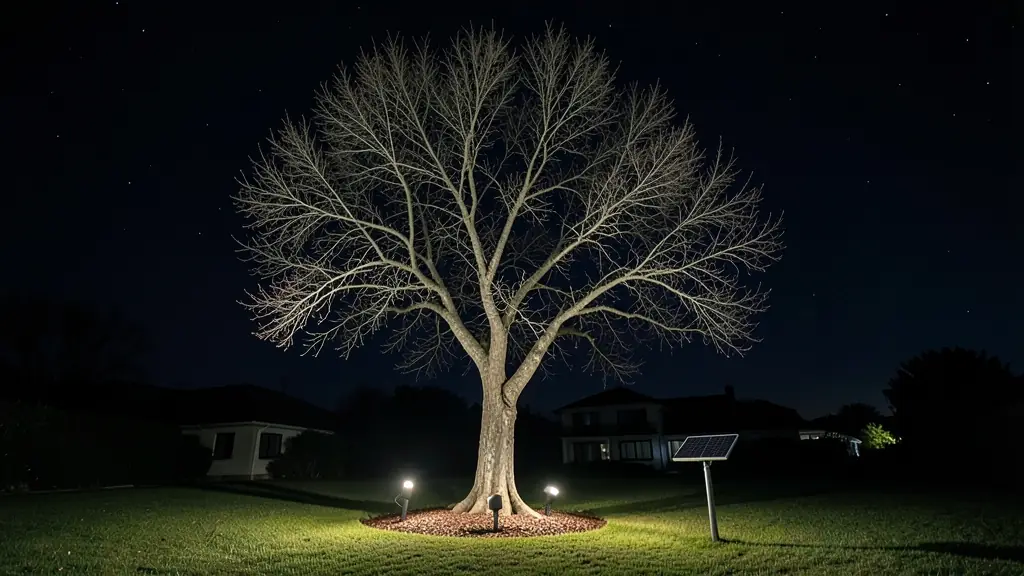
Solar lights spotlights do one job: put a narrow beam on a single thing. A jacaranda in a Pretoria garden, the name board at a guesthouse gate in Clarens, a statue in a church courtyard, the textured stone of a farmhouse gable. They are usually a small head on a spike with a hinge, sometimes with the panel on top and sometimes on its own stake on a cable. The trick is getting the panel into sun while the head sits in the shade of the very thing it lights.
Beam angle decides what you see
Beam spread is quoted in degrees. A narrow 15 to 30 degree beam climbs a trunk or picks out a sign; a 45 to 60 degree beam washes a wall or a shrub. Cheap heads have one fixed lens, so ask which you get.
Brightness here is modest: 100 to 400 lm a head suits a tree or a board in a dark garden. Two heads crossing from either side give shape; one from the front flattens it.
Warm white or cool white
- Warm white (around 3,000 K) suits bark, thatch, sandstone, face brick and anything on a stoep. It is the colour most homeowners mean when they say "nice".
- Cool white (5,000 to 6,500 K) suits a modern grey facade, aloes and silver leaves, and a sign that must read clearly from the road.
- Colour change heads are fun for a party, rarely for every night.
Cool white LEDs are usually a little more efficient, so on a small battery they give slightly more light for the same charge.
Panel on its own stake
The tree you want lit throws the shade that stops an all in one spotlight from charging. Under a canopy in July a built in panel may see an hour of weak light. Buy heads with the panel on its own spike and a lead of several metres, and push that spike into open lawn, tilted north. Look up your town's June figure on the sun hours page before counting on a full night. Bury the lead a hand's depth so the mower misses it.
Aiming up without blinding anyone
Set the head close to the base and tilt it so the beam runs up the object, not across the path or into a bedroom window. Walk the route a guest would take and look for the bare LED. For a business sign, aim from below and slightly to one side so drivers see the board, not the glare. For path and bed lighting around the feature, add solar garden lights; for a wide yard, a flood light does more than several spots.
What to put in your request
- What you want lit and roughly how tall or wide
- Whether it stands in shade during the day
- Warm white, cool white or colour change
- How far the panel must sit from the head
- How many heads and whether a landscaper installs
Solar Spotlights: who asks for them and why
- Homeowners and tenants: a jacaranda, a palm or a water feature in the garden picked out after dark
- Estates, complexes and body corporates: the entrance sign, the clubhouse facade and a row of palms on the main boulevard lit
- Farms, smallholdings and lodges: the farm name board at the gravel turn off seen by visitors arriving after sunset
- Shops, guesthouses, churches and offices: a guesthouse or wine farm sign at the gate lit without a trench across the driveway
- Municipalities and public contractors: a memorial, a statue or the trees in a town square lit where no cable runs
- Schools, clinics and sports clubs: the school crest board and a heritage building lit for evening functions and open days
- Mines, depots, yards and sites: a depot's name board and the reception block lit at a yard far from the mains
- Venues, events and campsites: trees and a ceremony arch at a wedding venue lit for the night and moved afterwards