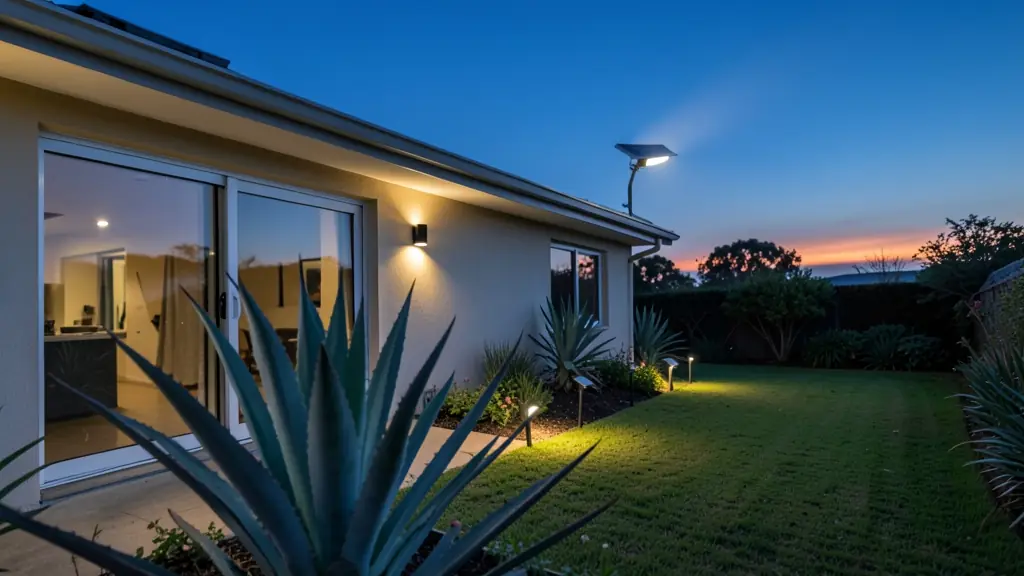
Every one of the solar lights for sale in South Africa, from a garden stake at a big hardware chain to a street head on a municipal tender, is built from the same four parts: a panel, a battery, a small controller and the LEDs. What you pay for is the size and quality of each. This page is the counter view: how those parts work together, how to read a box without being fooled, which kind of outdoor light suits which job, and what to tell a supplier so the quote fits.
The four parts and the one that matters most
- Panel. Turns daylight into charge. Its watts and where it faces decide how full the battery gets on a short June day.
- Battery. Stores the night. Ask for its watt hours (Wh), or the mAh together with the cell voltage. It fails first, and most boxes hide it.
- Controller. Switches the light on at dusk, stops the battery overcharging and runs the modes: dim, motion, timer.
- LEDs. Roughly 100 to 150 lumens per watt. More LEDs on the face say nothing about how long the light lasts.
A tiny cell behind a big LED board is bright for an hour, then dim.
Reading a box at the shop
Cheap boxes print a big "watts" number that is not the LED's real draw. Ignore it. Look for three things: lumens, battery capacity with its voltage, and the panel size. If the box gives none of them, the light is a guess. Check the IP rating too: IP65 handles rain, IP67 a short dunking. A battery warranty tells you more than a photo of a lit mansion. When a supplier cannot answer these, ask the next one.
Which kind of light for which job
- A yard, a farm shed or a parking area: solar flood lights, 1,000 to 3,000 lm.
- A front door, the stoep or a gate pillar: solar wall lights, 300 to 800 lm.
- Beds, paths and borders: solar garden lights, 100 to 300 lm.
- An internal road or a public street: solar street lights on 4 to 9 m poles.
- A spot that only needs light when someone walks by: motion sensor lights.
Where solar lights let people down
Most returns we hear about come back between May and August. The panel sat under an eave, behind a palm or facing south. The battery was cheap lithium ion that cooked in a Kimberley summer and lost half its capacity by winter. Or the light was set to full brightness all night with a battery sized for three hours. The test is a cold, cloudy week in George or Pietermaritzburg, not a clear December evening in Polokwane. The sizing calculator works out the battery and panel for your town's winter.
What to put in your request
- Say where each light goes and what it must light
- Give the hours of light you need a night
- Name your town so winter sun is allowed for
- Ask for lumens and battery Wh, not box watts
- Say if you want installation or delivery only
Solar Lights: who asks for them and why
- Homeowners and tenants: lights for the stoep, garden path, gate and driveway that keep working through load shedding
- Estates, complexes and body corporates: a mix of road heads, guard hut floods and common area lights for the body corporate
- Farms, smallholdings and lodges: floods over the yard and kraal and lights at far gates where no cable reaches
- Shops, guesthouses, churches and offices: car park, sign and entrance lights for a shop, guesthouse or church without trenching
- Municipalities and public contractors: street heads and park lights for tenders where grid supply is far or unreliable
- Schools, clinics and sports clubs: walkway, field edge and hostel lights for schools and clinics on a tight budget
- Mines, depots, yards and sites: perimeter and laydown yard floods for mines, depots and building sites
- Venues, events and campsites: path markers, lanterns and festoons for venues and campsites with no power points