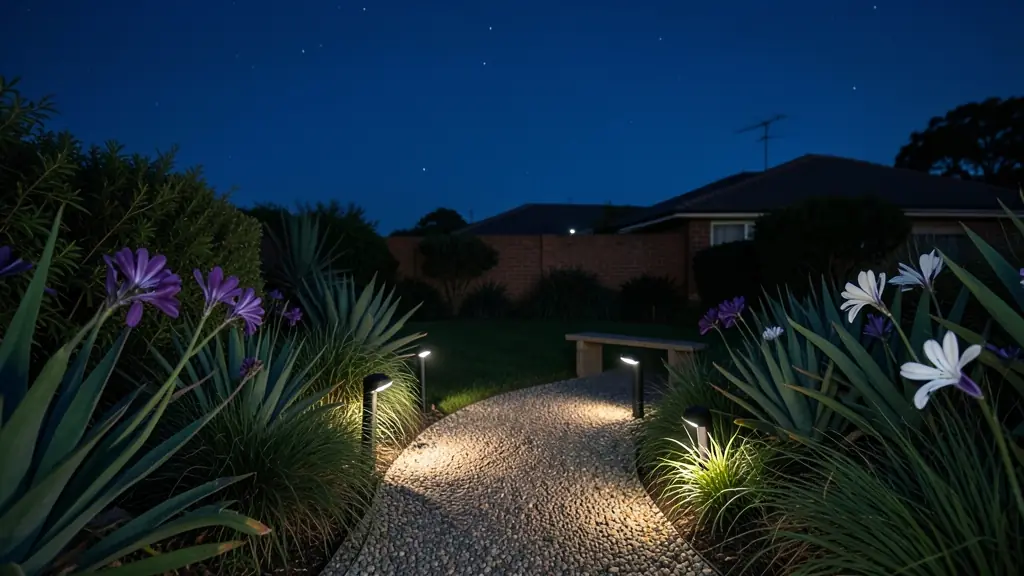
Solar garden lights are the small ones: stakes along a path, short bollards at a step, accent lights under a tree, markers on the edge of a bed. Most are bought in packs of six or ten, and most go dim by July. That is rarely bad luck. It comes from a small cell, a tiny panel and a spot under the shade of a shrub. Choose well and place them right, and a garden in Durbanville or Bryanston stays softly lit every evening of the year.
Stakes, bollards and accent lights
- Stake lights push into soil and give 5 to 100 lm. They mark a path; they do not light it.
- Bollards stand 40 to 80 cm tall on a base and throw 100 to 300 lm down onto steps and paving.
- Accent lights sit low and wash a shrub, a rock or a pot. For a tree, see solar spotlights.
- Path markers sit flush with paving and only show the edge.
For a lamp post at a gate or along a long path, go to solar pole lights.
Why they dim by July
A typical cheap garden light has a panel the size of a matchbox and one AA NiMH cell of 600 mAh. In December it charges fully in a few hours. In June the sun is low, the day is short, and the shadow of the boundary wall crosses the bed by two o'clock. The cell never fills, and after a few cold months it loses capacity too. On the Highveld the cold nights make it worse; in the Cape it is the rain. Better lights carry a larger panel, a cell of 1,200 mAh or more, or an 18650 lithium cell.
Cells you can replace
Turn the light over before you buy. A screw cover with a standard AA or 18650 cell means a ten minute fix when it fades. A sealed unit goes in the bin. Use rechargeable NiMH or the lithium type the light was made for, never alkaline. The battery replacement finder matches the cell, and solar light batteries covers the rest.
Placing them in the bed
- Stand where the light will go at noon in winter. If it is in shade, move it.
- Keep panels clear of plant growth; trim the agapanthus back by spring.
- Keep them out of the direct spray of sprinklers. Most garden lights are only rated IP44, which is splashes, not a jet every morning.
- Space path stakes about 1.5 to 2 m apart and keep them off the lawn line where the mower runs.
- Wipe the panels each month. Dust and hard water marks cut charge.
What to put in your request
- Give the path length or bed size in metres
- Say how much winter sun the spot gets
- Ask whether the cell can be replaced
- Choose warm or cool white
- Say if a landscaper should place them
Solar Garden Lights: who asks for them and why
- Homeowners and tenants: stakes along the path to the front door and soft light in the beds after dark
- Estates, complexes and body corporates: path markers and bollards along common area walkways and the clubhouse garden
- Farms, smallholdings and lodges: a few stakes around the farmhouse garden and the path to the guest cottage
- Shops, guesthouses, churches and offices: bollards at a guesthouse entrance and stakes round a restaurant courtyard
- Municipalities and public contractors: low path lights in a small park or a memorial garden with no supply
- Schools, clinics and sports clubs: markers along a garden path at a school, clinic or old age home
- Mines, depots, yards and sites: edge markers on walkways around site offices and change rooms
- Venues, events and campsites: rented stakes to mark a garden path to a ceremony or a parking field