The Science of Solar Energy Conversion
Photovoltaic Cells: The Core Technology
The sun discharges roughly 1,000 watts of energy per square meter at peak daylight, a fact that underscores the fundamental physics powering solar lights how do they work. This radiant influx is captured not through heat, but through a purely quantum process. Within each photovoltaic cell, layers of doped silicon create an electric field. When a photon strikes the semiconductor material, it dislodges an electron, generating a direct current. This photon-to-electron conversion is governed by the photovoltaic effect, which relies on the precise band gap of the silicon lattice to absorb the visible spectrum efficiently.
The conversion efficiency of these cells depends heavily on the purity of the crystalline structure and the panel’s temperature coefficient. High temperatures degrade voltage output, which is why panel placement matters immensely.
– Charge controller efficiency
– Battery state of charge
– Solar irradiance levels
These factors determine the nightly operational duration. The direct current produced is then regulated and stored in a lithium-ion or lead-acid battery, which acts as the reservoir for nocturnal illumination. The journey from sunlight to stored potential is entirely silent, with zero moving parts, and it is this elegant simplicity that defines the engineering behind modern solar lights how do they work. This relationship between light absorption and electron flow constitutes the core technology by which daylight is transformed into usable luminosity, making the system remarkably resilient for off-grid applications.
How Sunlight Becomes Usable Electricity
In South Africa, where grid reliability varies by region, understanding solar lights how do they work means tracing the energy pathway beyond the panel. The photovoltaic array generates direct current, yet the luminaire requires controlled voltage and current to operate safely.
A charge controller mediates this flow, preventing overcharge and deep discharge. The battery stores the energy, but the final conversion occurs inside the LED driver. This component transforms stored power into consistent illumination across the evening hours.
The factors that shape nightly performance include:
– Temperature fluctuations
– Shading patterns
– Battery health
Solar lights how do they work ultimately depends on the harmony of these components. No inverter is required for DC LEDs, which keeps these fixtures efficient. The entire system operates on voltage that matches semiconductor requirements.
The Role of Semiconductors in Energy Generation
Semiconductors perform the essential work of solar energy conversion. They conduct electricity only under specific conditions, which allows silicon to respond predictably to sunlight. This property makes them ideal for photovoltaic cells.
When photons strike the semiconductor, they dislodge electrons from atoms. The electrons travel through the material, generating a direct current. Understanding solar lights how do they work requires recognizing this precise sequence.
- Doping adds impurities to improve conductivity
- Crystalline structure affects electron mobility
- Band gap determines the light wavelengths absorbed
The conversion remains efficient because no inverter is necessary for DC LEDs. I find that elegance genuinely satisfying!
Core Components Inside a Solar Lighting System
Solar Panels: Capturing Sunlight
South Africa receives over 2,500 hours of sunshine a year, yet the humble solar panel often goes unnoticed. To grasp solar lights how do they work, look past the glossy surface and into the panel’s practical design. I’ve seen panels fail for reasons that have nothing to do with electricity.
The panel is a sandwich of tempered glass, anti-reflective coating, and an aluminium frame. That glass shields the cells from hail and dust. The coating cuts reflection, letting more light reach the silicon. Even the frame matters; it anchors the panel against strong winds. A flimsy mount will cost you, trust me!
Placement is equally important. A panel angled toward the equator captures more sunlight during winter. A single shaded corner can drop output dramatically. So the panel’s physical integrity and position determine whether the whole system thrives.
Rechargeable Batteries: Storing Energy for Nighttime Use
The question of solar lights how do they work often stalls at the panel, but the real hero hides inside the housing. I once inspected a unit that stopped functioning after three months. The panel was pristine, the LEDs intact, yet the light sat dead every night. The culprit was a budget battery that had swollen from the heat. That physical failure taught me more about the system than any datasheet.
The rechargeable battery is the buffer between a sunny afternoon and a dark evening. It stores the energy harvested during the day and releases it at a controlled rate. Common chemistries include:
– Lithium iron phosphate (LiFePO4), which handles high temperatures without degrading.
– Nickel metal hydride (NiMH), an older but reliable option for smaller fixtures.
– Lead acid, rarely used now due to weight and maintenance needs.
The capacity matters as much as the chemistry. A battery rated in amp hours determines how long the light runs after sunset. In South Africa’s winter, when daylight hours shrink to about ten, the battery must hold enough charge to cover the longer night. Also, the charge controller protects the battery from overcharging, which can shorten its lifespan. The internal wiring must be solid, too. Loose connections cause voltage drops that make the light flicker or fail prematurely. So when you ask how solar lights how do they work, remember that cheap batteries create expensive problems. The panels gather the sun, but the battery keeps the promise.
Charge Controllers: Managing Power Flow Safely
Charge controllers govern the flow of electricity between panel and battery. This component decides when energy moves forward and when it must stop. On a cloudless South African morning, a panel can push voltage high enough to damage a battery if nothing interrupts the current. Any full answer to solar lights how do they work must account for this mediator.
The controller performs three essential duties:
- Regulating voltage so the battery receives a steady charge.
- Blocking reverse current when the panel goes dark at night.
- Disconnecting the load before the battery drains completely.
Pulse width modulation (PWM) units are common in budget fixtures. Maximum power point tracking (MPPT) controllers extract more usable energy from the panel, though they cost more. For a small garden light, simpler is often better. The controller also reads temperature and adjusts charge voltage for local conditions. South Africa’s heat accelerates battery ageing, so this safeguard matters.
LED Bulbs and Their Efficiency Benefits
Efficiency in a solar lighting system lives or dies by its light source. LED bulbs have become the standard because they convert most of their energy into visible light rather than heat. An incandescent bulb might waste ninety percent of its input as warmth. That waste would drain a small battery within hours. An LED draws a fraction of the power and produces a crisp, reliable glow for far longer. For the casual reader asking solar lights how do they work, the bulb is the final payoff.
South Africa’s high solar irradiance means panels generate ample energy during the day. But the system’s nighttime longevity depends on this efficient consumption. A well-matched LED allows the stored charge to stretch across dusk to dawn without straining the battery. The result is a fixture that operates consistently through winter’s shorter charging days.
- LEDs require lower forward voltage, matching typical battery outputs.
- Their long lifespan reduces maintenance costs in remote locations.
- Directional emission means less light is wasted on upward spill.
This efficiency reduces required panel and battery sizes, lowering the overall system cost. The interplay between generation, storage, and consumption becomes more forgiving. A smaller battery can cycle less deeply, prolonging its life. The LED’s slow degradation curve keeps light levels steady for years.
Light Sensors: Detecting Daylight and Darkness
The quiet genius of any solar light is often the last thing people notice. A passerby sees the glow and assumes the panel did all the work. But solar lights how do they work in practice depends heavily on a small component called the light sensor. This device, usually a photoresistor or a photodiode, measures ambient brightness and decides the exact moment to switch the fixture on or off. It performs this ritual twice a day, without drama, and rarely receives any credit.
During the afternoon, the sensor faces a flood of photons. It keeps the circuit open, letting the panel charge the battery undisturbed. As dusk approaches, the light levels drop to a specific threshold. The sensor detects this shift and closes the circuit, allowing stored energy to reach the LED. The transition feels seamless, but it is actually a precise electrical handshake. The sensor’s sensitivity determines whether your garden lights appear before the neighbours’ or lag behind like a reluctant guest.
Some sensors come with a small delay circuit. This prevents a passing car’s headlights from triggering the system. A sudden flash of brightness at 9 p.m. would otherwise confuse the sensor and shut the light off mid-evening. The delay ensures stability. It also means the sensor ignores brief anomalies and only responds to a sustained change in ambient light.
- Photoresistors are inexpensive and common in basic residential fixtures.
- Photodiodes offer faster response times for commercial or security lighting.
- Some advanced sensors use multiple detection points to avoid false triggers.
The placement of the sensor matters as much as its type. If the sensor sits too close to the LED, it can detect the fixture’s own glow and turn the light off in confusion. Manufacturers avoid this by shielding the sensor or positioning it on a separate plane. This is why you often see a small translucent dome on the top of the housing. That dome is the sensor’s eye, and it must look upward to catch the sky’s true brightness.
South African evenings arrive quickly in certain seasons. The sensor’s job becomes more important when daylight hours shrink. A well-calibrated unit will hold the light off until the last useful ray fades, preserving battery charge for the long night ahead. It is a small choreographer, ensuring the system performs its nightly routine with quiet precision.
The Daily Work Cycle: From Dawn to Dusk
Daytime Charging: How the Panel Absorbs Sunlight
South Africa’s sun beats down for over 2,500 hours each year. That raw abundance powers the question of solar lights how do they work. At dawn, the panel begins to absorb those first pale rays. The low angle yields a weak current, barely enough to start charging. By midday, the sun is overhead, and the panel hits its full output. Then the afternoon fades, and the current drops away.
The daily charging follows an exact sequence:
- Morning light starts the flow.
- Noon sun maximizes the charge.
- Dusk ends the process, triggering the sensor.
Each day is a silent transaction between sunlight and storage. The panel works only while the sun is up, filling the battery for the night ahead.
Dusk Detection and Automatic Activation
As the sun slips below the horizon, the light sensor registers the change. This moment sets the entire system into motion. The solar panel, which spent the day feeding the battery, now sends a signal to cut off the charging flow. Simultaneously, the battery starts powering the LEDs. This seamless transition is the heart of solar lights how do they work.
Dusk detection follows a precise sequence:
- The sensor measures ambient light.
- The controller compares it to a preset threshold.
- The switch flips from charging to discharging.
- The LEDs illuminate.
All of this happens in less than a second. For South Africans, this means lights that switch on exactly when needed, even as the last orange glow disappears. Understanding this cycle clarifies the daily operation.
Nighttime Operation: Releasing Stored Energy
The morning revival is where the true genius of the system reveals itself. As the first rays peek over the horizon, the solar panel detects a rise in ambient light. The controller notices this shift and promptly halts the discharge of power to the LEDs. In a flash, the unit switches back into charging mode. The battery, depleted from its nightly duty, begins to receive fresh energy. This entire sequence is a daily ritual that many homeowners take for granted.
The progression of the day dictates the battery’s state:
1. Early morning: The battery is at its lowest capacity.
2. Midday: Peak sunlight floods the panel, rapidly restoring the charge.
3. Afternoon: The charge controller regulates the flow to prevent overcharging.
4. Early evening: The battery sits at full capacity, ready for the night ahead.
This is the essence of solar lights how do they work. The panel spends the daylight hours carefully replenishing the lithium cells. It is a constant balancing act, managing the absorption rate against the current consumption needs. By the time the night falls, the stored energy is primed and waiting. The transition is abrupt yet perfectly timed. The moment the sensor trips, the stored current leaps into action. The LEDs draw down the battery’s power, releasing the captured sunlight as a bright, steady glow. This nightly release is the payoff for a day spent in the sun. The complete story of solar lights how do they work hinges on this quiet exchange of energy between the panel, battery, and bulbs. For a South African garden, this means consistent illumination, even after a cloudy day, provided the battery had enough time to reach a sufficient state of charge.
Morning Shutdown and Restarting the Cycle
Solar lights how do they work reveals itself most clearly in the quiet moments of the morning. The abrupt cessation of light is as important as its generation. The sensor, having detected the rising luminescence, cuts the circuit to the LED. The night shift ends without ceremony. The battery, now in a state of deep depletion, begins its slow recuperation. This cycle is a daily resurrection, a constant renegotiation between consumption and conservation.
The morning shutdown is not a simple switch flip. It is a sequence of calibrated decisions:
– The light sensor registers a specific lumen threshold.
– The charge controller disconnects the load to prevent battery strain.
– The photovoltaic cells begin accepting the first available photons.
– The system resets its internal clock for the day ahead.
This restart is the engine of the entire operation. The panel shifts its function from producer to recharger. For the South African homeowner, this means that every sunrise starts a silent, automated process of preparation. The energy economy of the garden is recalibrated, and the promise of another night’s illumination is forged in these early hours. Understanding this daily reset is fundamental to grasping solar lights how do they work, as the system’s longevity depends on this seamless transition. The cycle is not merely mechanical; it is the very pulse of the device.
Different Types of Solar Lights and Their Working Mechanisms
Solar Garden Lights: Simple Self-Contained Systems
When I walk through a South African garden at dusk, I see dozens of small lights switching on without a single wire. These solar garden lights are the simplest proof of solar lights how do they work. They bundle every component, the panel, the battery, the sensor, and the LED, into one compact unit that anyone can stake into the ground.
Unlike larger systems that split parts for performance, garden lights use a self-contained architecture. The panel sits on top, the battery rests below, and the light sensor faces outward. This integration cuts cost and makes installation effortless. You just place them in direct sun and let the built-in circuitry handle the rest.
Different garden light styles suit different spaces. Common configurations include:
- Stake lights for pathway edges
- Wall-mounted sconces for patios
- Decorative lanterns for outdoor tables
Each variant uses the same internal layout, only the housing changes. That design consistency is why these units remain reliable across years of rainy and sunny seasons.
Solar Floodlights: High-Output and Sensor-Driven Design
Solar floodlights answer solar lights how do they work on a larger scale, but the internal story is different. Where garden lights merge every component into one body, floodlights separate the panel from the lamp. This allows a larger photovoltaic array and a bigger battery, which feed a far brighter LED.
The sensor-driven design is what sets these units apart. A passive infrared sensor detects body heat and triggers a burst of high-output light, not a gentle dusk glow. A sudden defensive brightness! Some models use a dusk-to-dawn sensor to keep the lamp dim for the whole night. Both approaches rely on a charge controller to wake the system and route stored energy.
The result is a unit built for practical threat detection. Larger circuits handle higher current. Heavier wiring resists heat. The panel charges in daylight, and the sensor decides when circumstance demands the light be seen.
Solar Street Lights: Large-Scale Power Management
Grid independent street lights show how solar lights how do they work on municipal scale. The panel mounts high on the pole, free from shadows. The battery bank sits below in a sealed cabinet. This separation allows a photovoltaic array ten times larger than a garden light’s unit, and a battery robust enough to power hundreds of LED lumens for twelve hours!
Nightly operation depends on a central controller that coordinates the battery bank and the luminaire. This controller handles solar lights how do they work when the load spreads across a hundred lamps. Smart dimming schedules cut brightness after midnight, stretching reserves until dawn.
- Deep cycle batteries tolerate frequent charge and discharge cycles.
- Lithium iron phosphate cells weigh less and last longer.
- Remote diagnostics flag a failing panel or an underperforming cell.
These systems manage energy for an entire street, not a single garden lamp.
Solar Path Lights: Low-Profile and Decorative Operation
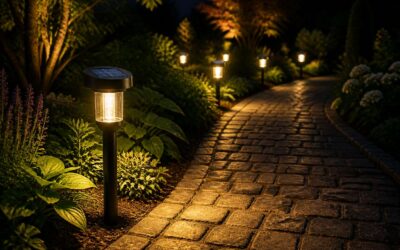
Solar path lights are compact units that sit near the ground and mark walkways. Their working mechanism keeps all parts together: a panel on top, a battery below, and a light sensor on the side. Because they are low, they receive less direct sunlight than elevated panels. Designers compensate with a single LED and a smaller battery.
At dusk, the sensor closes the circuit and the battery discharges slowly. The panel, though tiny, can still fill the battery during a typical South African day. Some path lights use a prism to distribute light evenly. Others use a simple reflector.
- A polycarbonate lens resists knocks
- A ground stake keeps the battery cool
- A rubber gasket stops moisture
These details answer solar lights how do they work at the smallest scale. They do not compete with floodlights. They simply make the path visible.
Solar Security Lights: Motion Detection and Remote Control
Solar security lights twist the classic question of solar lights how do they work into a more active form. These units rely on passive infrared sensors to detect body heat and movement. When triggered, the controller releases stored energy at full output, which is a far cry from the slow discharge of path lights. This design conserves battery power because the lamp only runs when needed. Some models include remote controls to override the sensor or adjust the duration.
A typical security system uses:
1. A PIR sensor with adjustable sensitivity.
2. A separate LED array for wide illumination.
3. A remote receiver for manual switching.
The panel is often mounted independently, so it can sit higher while the lamp attaches near an entry point. In South African weather, that separation ensures a full charge even if the light itself stays shaded during the day.
Hybrid Solar Lights: Battery and Grid Integration
Hybrid solar lights answer the question of solar lights how do they work by adding a second power source. These systems still use photovoltaic cells and batteries, but they also connect to the municipal grid. When the battery runs low, the unit draws a small amount of alternating current to keep the light running. This design matters in South Africa, where winter sun can be unpredictable.
The controller plays a larger role in hybrid units. It decides which energy source to use based on battery voltage and available sunlight.
A typical hybrid setup includes:
– A solar panel for daytime charging.
– A lithium battery for primary storage.
– A rectifier to convert grid power to direct current.
– A charge controller that prioritises solar energy.
The grid acts as a safety net, not a primary supply. That distinction changes how solar lights how do they work in practice. The system draws grid power only during extended cloudy periods. This reduces electricity costs while maintaining consistent illumination. Some models can even sell excess power back to the grid, turning the light into a small generator.
Factors That Affect Solar Light Performance
Sunlight Exposure and Proper Panel Placement
Most questions about solar lights how do they work ignore installation context. A panel mounted in shade performs worse than a modest panel in full winter sun. In South Africa, the sun tracks lower across the north during June, so a light fixed under a thatched overhang captures only a fraction of its potential charge.
- Orientation: face panels true north, not magnetic north.
- Tilt: set near your latitude, roughly 25 to 34 degrees.
- Obstructions: trim branches that cast afternoon shade.
- Cleanliness: dust and bird droppings reduce absorption.
Proper panel placement means studying your property’s daily light path, not picking a convenient wall. Morning sun charges less effectively than midday light, so give the panel at least five uncovered hours! A complete answer requires acknowledging that geography and human habit shape the outcome.
Weather Conditions and Seasonal Variations
Weather dictates the gap between theoretical efficiency and actual performance. Overcast skies scatter sunlight, yet a solar panel still captures diffuse radiation, though at reduced strength. Rain cleans the glass but blocks incoming rays. Temperature also matters; extreme heat lowers voltage output, while cold mornings improve conductivity. For those asking solar lights how do they work, the answer shifts daily.
Seasonal changes in South Africa create stark contrasts. Winter brings shorter daylight hours and a lower solar arc, reducing total charge. Summer offers extended sunshine, but afternoon thunderstorms can interrupt the charging window. The same fixture performs differently in Johannesburg versus Cape Town due to regional cloud patterns.
- Cloud cover can cut output by 60 to 80 percent
- High humidity increases light scattering
- Seasonal dust and pollen accumulate on panels
Battery Quality, Capacity, and Lifespan
The battery determines how many charge cycles a solar light survives and how many hours it illuminates after sunset. A cheap lithium cell might deliver a year of service. A quality deep-cycle battery can last five years or more in South African conditions.
Capacity, measured in milliamp hours (mAh), controls how much energy the fixture stores. Higher capacity means longer runtime but also longer charging windows. The right balance depends on your nightly usage patterns.
Lifespan hinges on discharge depth. Draining a battery completely every night shortens its life considerably. Modern charge controllers prevent full discharge, protecting the chemistry inside.
- Nickel-metal hydride batteries handle heat well
- Lithium iron phosphate offers the longest cycle life
- Lead-acid remains cost-effective for large installations
When someone asks solar lights how do they work, the battery answer is simple: they store what the panel collects during the day.
Climatic Factors: Temperature and Humidity Effects
The same South African sun that powers a solar light can also destroy it. When someone asks solar lights how do they work, they rarely consider that the answer shifts with the weather. Heat accelerates chemical reactions inside batteries, which sounds useful, but excessive heat degrades electrolytes and shortens cell life. A Highveld summer afternoon can push internal temperatures far beyond the ambient reading.
Humidity is equally capricious. Coastal air, laden with salt and moisture, corrodes contacts and clouds lens surfaces. Condensation inside a sealed housing creates micro-shorts that drain stored energy before dusk even arrives.
Common climatic culprits include:
– Thermal cycling that cracks solder joints
– UV exposure that yellows polycarbonate lenses
– Salt spray that attacks uncoated circuit boards
In my experience, a well-designed fixture accounts for these variables with thermal management and protective coatings. That distinction separates a product that survives five Cape winters from one that fails within a single summer.
Troubleshooting and Optimizing Solar Lighting
Common Issues: Dim Light and Short Runtime
Dim output or early shutdown usually points to a disruption in the energy cycle. Your system only performs as well as its weakest component, and often the battery is the culprit. After a few hundred cycles, internal resistance rises and capacity fades, which directly reduces the stored energy available for the night.
South African winters bring shorter days and lower sun angles, which limits the charging window. Additionally, dust and bird droppings on the panel act as a barrier, blocking the photon absorption needed to generate electricity. When you understand solar lights how do they work, you recognize that any reduction in input directly impacts the output.
Here is the typical degradation sequence:
1. Solar panel output drops below the charge controller’s threshold.
2. The battery never reaches a full state of charge, leading to sulphation.
3. The LED driver receives lower voltage, resulting in visible dimness.
4. The protection circuit cuts power early, shortening the runtime.
You can often restore performance by cleaning the panel surface and checking for shade cast by new vegetation. For older units, replacing the rechargeable battery is the most reliable fix. The fundamental principle of solar lights how do they work involves a delicate balance between energy harvest and consumption; correcting the imbalance is a straightforward process when you know where to look.
Cleaning and Maintaining Solar Panels
Cleaning the photovoltaic surface restores output quickly. In South Africa, Highveld dust or seasonal pollen can reduce photon absorption by nearly a third. You need no specialised chemicals. I use water and a soft cloth on my own units.
The maintenance sequence works best when ordered:
- Disconnect the battery to prevent short circuits.
- Wipe the glass panel in the early morning to avoid thermal shock.
- Inspect for microcracks or opaque film from hard water.
After cleaning, measure the output voltage with a multimeter. This observation confirms whether the panel is recovering. Remember, solar lights how do they work depends on unobstructed sunlight. Bird droppings and mineral deposits act as insulators, breaking the energy cycle.
Battery Replacement and Upgrading Tips
Battery degradation often masquerades as a panel problem. If your light flickers past midnight or dims earlier each week, the storage cell likely needs attention. I recommend testing the battery voltage after a full charge cycle. A reading below 1.2 volts per cell for nickel metal hydride units means replacement is overdue. For South African conditions, upgrade to lithium iron phosphate batteries, they handle heat better and last longer.
Consider these warning signs:
- Runtime shrinks by more than half
- Swelling or corrosion at terminals
- Charging stops after short exposure
When upgrading, verify the charge controller supports the new chemistry. Solar lights how do they work after a battery swap depends on matching voltage and capacity. A larger capacity extends nighttime operation but requires adequate panel output to replenish it fully.
Positioning Adjustments for Maximum Efficiency
A single shadow can cost two hours of runtime. I have seen systems where a roof overhang touches the panel face for only 30 minutes each morning, yet the battery never fully recovers. The sun’s path shifts across South Africa, so a fixed mount loses alignment over autumn. Correcting the tilt angle twice a year changes everything.
Most people ask solar lights how do they work, but the real issue is often placement. Understanding solar lights how do they work in practice means testing the sensor, not just the panel. A light facing west triggers early because the sensor catches horizon glow.
- reflected glare from windows or pools
- streetlights that confuse the photocell
- dense shrubs trapping heat around the housing


0 Comments