Understanding Solar Light Brightness
What Are Lumens and Why They Matter
Most people misjudge brightness by wattage. Lumens tell the truth. They measure the total visible light a source emits, and they determine whether a solar fixture casts a faint glow or floods a driveway with light.
For solar lights outdoor bright, lumens reveal true output. I have tested fixtures that claim high wattage yet deliver a weak glow. A 1000 lumen fixture visibly illuminates a parking area, while a 30 lumen marker outlines a path. Here is a practical scale:
– Garden borders and walkways: 10 to 50 lumens
– Patio seating areas: 100 to 300 lumens
– Security perimeters: 700 to 1200 lumens
South Africa’s intense sunlight gives panels a strong charging window. Yet solar lights outdoor bright depend on the pairing of a quality panel with an efficient LED array. The lumen rating settles it. It tells you what your yard will look like after dark.
Comparing Brightness Levels Across Solar Fixtures
Brightness across solar fixtures is rarely uniform. Two units with the same lumen rating can produce different results. A floodlight with a narrow beam concentrates output into a small area, while a path light spreads the same light across a wide arc. That difference changes what you see after dusk.
Housing and lens design also matter. Clear glass delivers sharper intensity; frosted diffusers soften and scatter the glow. Even solar lights outdoor bright can look dim if the battery depletes early. South African winters, though mild, shorten charging hours. Fixtures with larger batteries hold steady output for longer periods.
- Floodlights for targeted coverage
- Wall lights for verandas and entryways
- Spotlights for accenting trees or features
When comparing fixtures, examine beam angle and battery capacity alongside the lumen figure. That combination defines real brightness. For solar lights outdoor bright, panel size also influences how quickly the battery refills.
Battery Capacity and Its Impact on Illumination
Three hours. That is how long many solar fixtures maintain full brightness before their batteries surrender. What happens after that is entirely dependent on battery capacity. The best solar lights outdoor bright in South Africa hold their output through the evening, while weaker cells fade gradually, leaving a dim glow that barely reaches the pavement.
Battery capacity determines the effective illumination period. Watt hours, not milliamp hours, tell you how long a fixture sustains its rated output. A 10Wh battery driving a 5W fixture gives two hours at full power. I have tested units with impressive mAh ratings, yet runtime disappointed because the discharge curve dropped steeply after the first hour.
For homeowners who rely on fixtures through extended evenings:
- Capacity above 2000mAh maintains brightness past midnight
- Lower capacity suits pathway lighting with shorter duty cycles
- Matching panel wattage to battery size prevents undercharging
The relationship between storage and output shapes every decision about placement. A bright fixture with insufficient storage is just a brief spectacle!
Types of High-Performance Outdoor Solar Lighting
Floodlights for Wide-Area Coverage
A single floodlight rarely satisfies the demands of a sprawling farmyard or a long driveway. Wide-area coverage calls for specialised fixtures with broader beam angles and rotatable lamp heads. In my experience, the split-panel floodlight is a compelling option, where the photovoltaic array sits apart from the lamp housing, allowing you to angle the panel toward the northern sun while pointing the beam where darkness actually gathers.
Consider these configurations when planning your installation:
- Floodlights with 120 degree lenses for perimeter walls
- Twin-head units that spread illumination in opposing directions
- Wall-mounted models with adjustable brackets for uneven terrain
South African winters bring shorter daylight hours, yet a fixture with a wide beam angle and a separate solar panel still holds illumination until the early hours! These floodlights deliver solar lights outdoor bright performance across distances of twenty metres or more when the optics match the specific layout.
Motion Sensor Lights for Security and Convenience
According to the CSIR, over 1.8 million households experience break-ins annually, yet most perimeter lighting remains static. Motion sensor lights alter this pattern by converting idle darkness into a sudden, deliberate burst of illumination. The efficiency hinges on passive infrared detection and a responsive photocell that ignores daylight.
My own installations have shown that a well placed unit with a 12 metre detection range and a 90 degree sweep delivers solar lights outdoor bright performance exactly when intruders cross the threshold. The convenience factor is undeniable, no switches, no timers.
- Adjustable sensitivity for pets
- Three mode settings for always on, auto, or off
These fixtures draw minimal battery power in standby, reserving their charge for those crucial seconds of action.
Pathway and Garden Lights for Ambient Glow
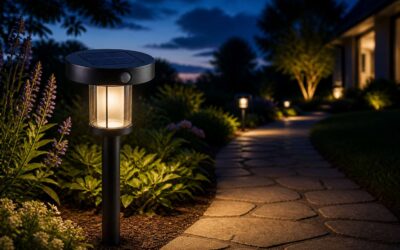
Pathway lighting serves a different purpose than security floodlights. It shapes the night garden with soft, inviting illumination. Downward-facing optics prevent glare and cast a gentle glow across stepping stones and flower beds.
I space fixtures at 2 to 3 metre intervals to create a continuous line of illumination without creating glare or hotspots. Selecting solar lights outdoor bright enough to mark a path, yet diffused enough to preserve the evening atmosphere, requires attention to beam angle.
Consider these placement options:
- Stake lights along the outer edge of the walkway
- Bollard lights at turns and steps
- In-ground well lights beneath low shrubs
Each option arranges light and shadow differently. In South African gardens, where load shedding remains a reality, these solar lights outdoor bright offer reliable ambient glow with no wiring and no electricity. They charge during the day and activate at dusk!
Wall-Mounted and Sconce Options
Wall mounted and sconce fixtures lift light to eye level. This changes how we perceive a courtyard or braai area. Instead of a downward beam, the light spreads outward and upward, washing a wall with brightness. For South African homes, this means security without the clinical glare of a floodlight.
Consider these high performance options when selecting solar lights outdoor bright:
- Integrated LED sconces with adjustable heads for directional control
- Wall packs with polycrystalline panels that mount separately for maximum sun exposure
- Decorative lantern styles that house warm LEDs and dusk to dawn sensors
Each type serves a purpose. A sconce near a door highlights the threshold. A wall pack on a boundary wall extends visible range. Matching the beam angle to the surface area is key. Narrow beams suit long walls; wider beams cover entries. With no wiring, installation takes minutes, and solar power autonomy remains a decisive benefit.
String Lights and Decorative Accents
There is no more direct way to challenge the evening than with a linear string of light. These fixtures redefine the space they occupy, turning a mundane patio ceiling into a canopy of illumination. In South Africa, where evening entertaining often moves outdoors, this type of lighting is essential. Hanging them over a dining table creates an intimate focus that a single overhead unit cannot replicate. For solar lights outdoor bright, these strings often use individual diodes spaced to distribute light evenly without hot spots.
The performance of these systems hinges on the quality of their wiring and the photovoltaic cells attached to the line. They must survive harsh UV rays and summer thunderstorms. When selecting a set, examine the connector seals and the thickness of the insulation.
– Weatherproof casings that resist cracking under intense sun exposure.
– A separable solar panel that allows placement in direct sun while the string remains in the shade.
– Wide-angle lenses that maximise the area of light spread below.
The most effective designs prioritise durability over sheer luminosity. A single decorative pendant hanging from a pergola can serve as a focal point. These accents are not merely functional; they contribute to the architectural shadow play on the walls of your home. The autonomy of each unit ensures that the garden remains bright even when the grid fails, a critical feature during load shedding. This combination of resilience and design is what makes these options a practical choice for any property looking to secure its perimeter while enhancing its atmosphere.
Key Features That Boost Solar Light Performance
High-Efficiency Solar Panels and Light Capture
The photovoltaic cell determines your fixture’s potential. A standard polycrystalline panel converts 15 to 17 percent of sunlight into usable energy. Monocrystalline alternatives push that figure past 20 percent. For South African gardens, where winter sun angles shift dramatically, that margin separates a gentle glow from a proper blaze!
Placement matters as much as construction. Shadows cast by a neighbouring wall can reduce output by half. I have watched homeowners install fixtures in shaded corners and then wonder why their solar lights outdoor bright ambitions never materialised. The panel requires direct exposure, ideally angled toward the equator.
- Panel size relative to the fixture determines reserve capacity.
- Textured glass reduces glare and improves absorption in low light.
Dirt accumulation quietly reduces output. A film of Highveld dust can diminish efficiency by a quarter within weeks, yet a quick wipe with a damp cloth restores performance.
Advanced LED Chips for Superior Output
The LED chip is the silent engine of every luminous fixture. Standard diodes produce around 80 lumens per watt, yet advanced chips, like those using flip chip technology, surpass 200 lumens per watt! For South Africans seeking solar lights outdoor bright, this efficiency gap determines whether a pathway sparkles or merely glows.
Quality chips manage thermal load better. I have tested fixtures where a properly bonded chip stays cooler, preserving both brightness and lifespan. Some models now integrate multiple chips with individual lenses, creating a uniform beam without dark spots.
- Flip chip designs offer superior heat dissipation.
- Multi chip arrays provide broader coverage.
- High CRI chips render garden colours accurately.
Reflector geometry also matters. Deep reflectors concentrate light precisely, making every lumen count. The marriage of advanced LEDs and smart optics transforms modest wattage into penetrating radiance.
Adjustable Heads and Directional Lighting
The real power of a fixture lies in its ability to aim. Adjustable heads transform a static light source into an instrument of precision. I have watched a single bollard light, tilted just so, turn a dull pathway into a sharp, extended pool of light. For South Africans, this means directing solar lights outdoor bright exactly where they matter: onto a braai area, a security gate, or a shadowed corner.
Directional lighting also reduces waste. A swivel mechanism with a locking collar holds the beam steady through Cape Town’s infamous south-easter. A gimbal mount offers even finer control. The payoff for solar lights outdoor bright is enormous when dusk settles over the garden.
– Tilt ranges of 180 degrees allow wall washing or downlighting.
– Locking hinges prevent sagging over time.
– Glare shields cut spill into neighbouring properties.
Every degree of adjustment contributes to overall brightness perception.
Dusk-to-Dawn Sensors and Smart Controls
A sensor that ignores the sunset is worse than no sensor at all. It drains the battery, spooks the dogs, and gives the neighbourhood something to whisper about. Dusk to dawn sensors are the quiet mechanism behind solar lights outdoor bright, deciding exactly when stored energy becomes visible light. They read ambient conditions and respond without drama.
Smart controls raise the standard. A photocell measures light levels. A timer accommodates your evening schedule. Remote adjustments allow fine tuning without a ladder. The best fixtures combine these elements into one coherent unit.
What separates a useful fixture from an annoying one:
- Response time to changing conditions
- Consistency across winter and summer
- A manual override for nights you prefer darkness
In South Africa, load shedding has sharpened our awareness of stored power. A sensor that avoids the flicker of cheaper units offers a quiet relief. A light that behaves itself feels considerably brighter when you need it most!
Installation and Placement Tips for Maximum Brightness
Selecting Sunny Spots for Optimal Charging
The sun plays a cruel trick on the garden, flattering one corner with gold while leaving another in the shade. A solar light is a slave to its solar panel, and the panel is a slave to your roof lines, trees, and that neighbour’s new two storey double storey. We often ask too much of these fixtures, expecting them to perform like a municipal streetlamp. Yet they are merely collecting photons for the long, dark night ahead.
Your primary duty is to perform a surveillance of your own property, tracking the sun’s path as it shifts with the seasons. A spot that basks in daylight during November may be a lonely, shadowy patch by April. When you install, tilt the panel to face north in our hemisphere. The perfect installation angle is often steeper than you think. Placing the light under a dense canopy of trees is a common tragedy that leads to a disappointing dusk.
South African winters can be cruel to solar collection. The days are shorter, the sun sits lower, and the photovoltaic cells have a demanding schedule. When you position your fixtures to achieve solar lights outdoor bright output, you must consider the angle of the light more than the time of day. Morning sun is crisp and efficient, but the afternoon ultraviolet rays are what really pack the punch for the battery.
Consider the physical directions of the fixture as well. A light mounted on the south side of the wall will miss the majority of the day’s irradiation. These elements of placement dictate your evening output, no matter the quality of the LED chip.
There are a few standards that usually hold, whether you are illuminating the driveway or the braai area:
– Ensure the solar panel is not shaded by the gutter or eaves when the sun is at its peak.
– Keep the glass on the panel clean, as dust and pollen form an insulating layer against the light.
– Follow the seasonal path; move portable units to follow the winter sun.
– Adjust the angle of the panel to compliment your specific latitude.
The physics of this is simple, but the execution is rarely perfect. We tend to mount these things quickly, plugging them into the wall in a state of mild optimism before the load shedding schedule changes again. But the fixtures appreciate a little more thought. If you place them where they can stare at the sun all day, they will reward you with a brightness that actually makes the pathway visible.
Angling Panels and Fixtures for Even Light Distribution
Many people assume that pointing a solar fixture straight at the ground works. This creates a bright pool directly below and leaves the edges in darkness. For solar lights outdoor bright performance, tilt the fixture head upward and outward to spread the beam across a wider area.
The panel angle deserves attention. In South Africa, a 30 to 35 degree tilt suits most latitudes. Winter demands a steeper angle to catch the lower sun.
From my installations:
- Set the panel angle to match your latitude, then adjust 10 degrees steeper for winter.
- Tilt the fixture head toward the centre of the area you want illuminated, not straight down.
- Space multiple fixtures so their beams overlap slightly, preventing dark gaps.
A fixture mounted too high scatters light uselessly. Mount it lower, two to three metres, angle it downward at 15 degrees. This delivers solar lights outdoor bright output where people actually walk.
Cleaning and Maintenance for Sustained Performance
Installation determines everything. A fixture under a tree canopy never reaches its full potential. In South Africa, theft and weather are real concerns. Mount fixtures securely, but keep them accessible. Dust accumulates on solar panels faster than most owners expect. Wiping the panel with a damp cloth every few weeks restores efficiency. I have seen installations lose thirty percent of output in a single dusty Highveld month.
Cleaning determines performance as much as placement. Check battery terminals twice a year. Corrosion appears quietly. Bird droppings, leaves, and mineral deposits block sunlight. For solar lights outdoor bright, the panel needs clear exposure.
Placement factors:
- Mount panels away from reflective windows that confuse sensors.
- Keep fixtures clear of sprinkler spray, which leaves hard water marks.
- Trim overhanging branches as seasons change.
Routine maintenance prevents slow dimming that owners blame on failing hardware.
Choosing the Right Bright Lighting Solution for Your Yard
Assessing Your Outdoor Space and Lighting Needs
Your yard doesn’t need more light. It needs the right light. Before choosing solar lights outdoor bright, survey your space. Walk the perimeter at night! Note dark corners, steep steps, and wide open areas. This reveals where illumination matters most.
Consider how you use each zone. A braai area demands focused brightness. A garden path only needs a soft glow. Security concerns change everything. Think about glare from neighbours and passersby. Solar lights outdoor bright only work well when placed where they can charge properly.
When assessing your needs, prioritise:
- Safety hazards like steps or uneven ground
- High traffic zones that need consistent illumination
- Areas where you entertain or relax after sunset
Your choices should match these realities. A single powerful floodlight won’t help a narrow walkway. Similarly, decorative lights won’t secure a driveway. Let your yard’s actual conditions guide the selection.
Matching Brightness to Specific Applications
Brightness becomes meaningful only when it matches the task. A 900 lumen fixture feels powerful in a driveway but overwhelms a small patio. The trick is studying each space for what it actually demands.
For entrances and walkways, look for solar lights outdoor bright enough to reveal edges and steps without blinding anyone. Entertainment zones need wider, softer coverage. Security perimeters require intensity that reaches the property line.
- High traffic areas: 400 to 700 lumens
- Relaxation spaces: 100 to 300 lumens
- Security focus: 800 lumens and above
These ranges are just a starting point. Your yard’s shape, surface colour and surrounding ambient light all shift the final decision. In my own testing, fixtures that perform well on open stands can feel harsh against white walls.
Weather Resistance and Durability Considerations
The South African climate tests every component of outdoor lighting. A fixture that performs well in Johannesburg may fade within months on the Cape coast. Salt air corrodes cheap housings, while UV rays yellow plastics. When choosing solar lights outdoor bright, prioritise powder coated aluminium or stainless steel. Sealed LED units resist moisture ingress.
- IP65 rating or higher for dust and water protection
- Tempered glass lenses instead of acrylic
- Gaskets around every seam
The battery compartment deserves special attention. Heat accelerates degradation, so ventilation matters. A durable solar light also needs a panel that withstands hail. In my testing, robust construction matters more than raw brightness when storms arrive. That longevity keeps your outdoor spaces consistently lit.
Battery Life and Replacement Options
Battery life determines whether your solar lights outdoor bright deliver consistent nights or fade by midnight. Lithium iron phosphate cells outlast older nickel metal hydride units, yet every battery eventually degrades. In South Africa, extreme heat shortens cycle counts. A replacement battery with matching voltage and connector type simplifies swapping. Always check the milliampere hour rating, not just the brand!
Sealed packs resist moisture better than bare cells. Over time, capacity drops; the light dims or shortens its runtime. When that happens, replacing the battery often restores performance without buying a new fixture.
- Compartment dimensions
- Charge controller compatibility
- Pack construction
The cheapest option rarely offers the same cycle life as a quality cell. Matching the original specifications prevents charging faults and premature failure.
Budgeting for Quality and Long-Term Savings
South Africans spend over R1.2 billion annually on outdoor lighting, yet most fixtures fail within two years. The difference comes down to upfront choices. A cheap unit forces replacement sooner, while a well built system delivers steady illumination for a decade.
Budgeting for quality means looking past the shelf price. Compare the cost per year of operation, not the initial rand amount. A robust solar light with a lithium battery costs more now, but saves on replacements. The cheapest options use thin plastics that crack under UV exposure.
- Check the ingress protection rating for dust and water resistance
- Confirm the warranty covers the LED board and battery
- Calculate the total cost over five years
When you invest in solar lights outdoor bright, you buy reliability. That consistency matters in South Africa, where load shedding makes dependable lighting a necessity. Quality units maintain their brightness through winter.
Reading Reviews and Comparing Top-Rated Models
A South African yard is a complex space. The sun hits the patio differently than the driveway. Reading reviews gives you the full picture. But a four-star rating hides a lot. The scrutiny lies in the comments. Look for owners who mention specific winter performance, not just aesthetics. They reveal how solar lights outdoor bright truly behave when the grid fails.
Comparing top-rated models requires a disciplined eye. Ignore the promotional images. Focus on the recurring complaints across different retailers. When I sift through feedback, I isolate three recurring threads:
- Actual beam spread versus the advertised angle
- The casing temperature after four hours of runtime
- The ease of swapping the battery without tools
This process separates marketing fluff from engineering. The right unit for your yard matches the review pattern, not the highest score. Those solar lights outdoor bright which survive the Cape Town wind and Highveld hail earn their place. They integrate seamlessly into the daylight cycle, ready for the evening.

0 Comments