Benefits of Solar-Powered Patio Lighting
Energy Efficiency
Loadshedding has taught South Africans to value autonomy. Solar lights patio systems offer that autonomy through impressive energy efficiency. Each panel captures daylight and stores it as electrical charge, ready for evening use. This process eliminates ongoing electricity costs.
The efficiency of modern photovoltaic cells has improved dramatically. You can illuminate a courtyard for hours using only a small fraction of the day’s sunlight. That translates directly to lower utility bills and a smaller carbon footprint.
Consider what this means for your household:
- No wiring or metering fees
- Battery storage that works during outages
- Minimal maintenance for years of service
Every photon collected is energy you do not purchase. Over a decade, these savings accumulate. You pay for the fixture, not for the fuel.
Cost Savings
The cost of grid electricity in South Africa has outgrown household income for over a decade. That reality reshapes how we value a home fixture. A solar lights patio arrangement serves as both a decorative element and a financial instrument that pays dividends every evening.
The savings begin with the installation itself. No trenching, no certified electrician, no municipal inspection fees. The fixtures run on stored daylight, so the monthly statement from your utility remains untouched. Over time, the cumulative effect is substantial.
- The average outdoor lighting setup consumes kilowatt hours you never see on a bill
- Solar fixtures hold their resale value
- Insurance premiums sometimes drop when permanent lighting is installed
For the homeowner, each illuminated evening represents money not spent. The sun charges the batteries, and the fixtures provide light. The arithmetic favors solar lights patio ownership, and the comfort arrives without a monthly price tag.
Easy Installation
Any South African who has juggled an electrician’s schedule knows the true luxury of a solar lights patio arrangement. It asks nothing of the grid, but more importantly, it asks nothing of your calendar. Installation is a quiet, forty minute ritual. Unpack, position, tighten, vanish. There is no trenching, no certified electrician, no municipal inspection.
Consider the items that never touch your to do list.
- Wiring diagrams that baffle the sane
- Municipal permits that require two government offices to speak to each other
- A dedicated circuit breaker
The fixture charges while you are at work and performs at dusk. You are merely the person who chose the spot, a decision that takes less time than choosing a takeaway order. That ease is the quiet miracle of solar lights patio ownership.
Environmental Impact
In a country where the daily load-shedding schedule can dictate the rhythm of an evening, the environmental argument for a solar lights patio ceases to be abstract. Every hour of dusk illumination drawn from a battery instead of the grid represents a minute of reduced strain on our coal fired power stations. The carbon footprint of your evening braai, the one that glows without a single cable snaking from the house, shrinks with every sunset.
The true measure of this impact lies in what you don’t consume. Consider the lifecycle of a standard patio light fixture. You are taking a single device entirely off the grid, removing its demand from the energy mix. This is not a grand gesture of activism. It is a quiet, permanent subtraction of your household’s electrical load.
– No standby power is drawn from Eskom during the day.
– No diesel or coal is burned to keep a single bulb running.
– No light pollution is wasted on empty garden corners, as the sensors only activate when movement is detected.
The absence of wiring also implies the absence of maintenance. There are no buried cables to degrade and leach copper into the soil, no plastic conduits cracking under the African sun. The localised generation of power at the point of use eliminates transmission loss entirely. I find that detail particularly satisfying. The energy you harvest on your roof path is spent exactly where it was gathered, a closed loop of solar gain and photonic release that leaves the surrounding landscape untouched.
Low Maintenance
The best maintenance schedule for a solar lights patio is having no schedule at all. Once the units are mounted, they demand nothing from you. No bulbs to swap every few months. No wiring to inspect. No corroded sockets to tolerate.
This is a genuine relief in South Africa. Our rain, wind, and relentless UV exposure shorten the lifespan of conventional outdoor lighting. Solar units handle it.
Here is what you sidestep:
- Electrician callout fees for fault finding
- Digging up garden beds to trace broken cables
- Annual rewiring or socket replacements
Your actual maintenance routine? Wipe dust off the panel when you remember. Tighten a screw once a year. Done.
Design Versatility
The most overlooked feature of a solar lights patio is that nothing is permanent. Most people treat lighting as a fixed installation. That assumption quietly limits every design decision that follows. No trenching, no junction boxes, no predetermined light points. Every fixture is portable. You can gather light for a braai on Friday, then scatter it toward the garden for a quiet Saturday evening.
I rarely see this freedom with mains powered systems. The current range of solar fixtures includes:
- Warm string lights for overhead ambience
- Focused spotlights for architectural details
- Low bollards for walkway definition
- Wall sconces for a conventional look
Mixing these on one patio creates layered illumination you can adjust on a whim!
Types of Solar Lights for Outdoor Patios
String Lights
A single strand of light transforms a dusky stoep into a gathering place! When selecting solar lights patio string options, think first about the mood you want to create. The choices divide into three families.
- Fairy lights: delicate diodes on thin wire, ideal for weaving through potted ferns.
- Globe lights: larger, warm spheres that cast a wide glow across a dining table.
- Edison-style filaments: visible wire coils that evoke an industrial, old-fashioned charm.
Each type reshapes the geometry of your outdoor room. I have found that globe lights suit sprawling entertainment areas, while fairy lights create quiet corners for reading. Placement dictates the effect, not the fixture alone. A solar lights patio arrangement should respond to your evenings, not the other way around.
Path Lights
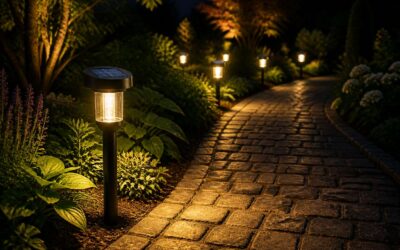
As the sun abandons the horizon, a shadowed garden path becomes an uncertain passage. Path lights, those low sentinels of the driveway and walkway, do more than illuminate; they anchor a solar lights patio setup to the earth itself. These fixtures carve lines through the gloom, directing footsteps and framing the dark flowerbeds that flank the lawn.
Unlike the ambient wash of string lights, these units are practical artisans of the dark. They are commonly placed to mark steps, driveway edges, or the winding walk to the front stoep. In the South African evening, where the sky falls quickly, they provide safety without the hum of grid power. Their warm, downward cast pools on the gravel and stone, creating a quiet map of your domain.
You will find several distinct variations in the market for this task:
- Stake lights, with their slim spikes and domed caps, are the most prevalent, piercing the soil with ease.
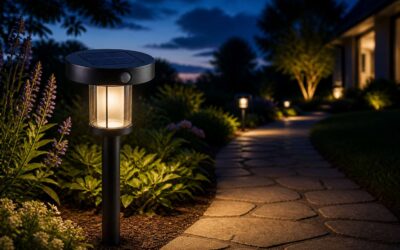
- Bollard lights offer a sturdy, flush profile, perfect for formal pathways.
- Deck and step lights are recessed into the structure itself, ideal for engineering a clean, unbroken plane of light.
Selecting the right one depends on the terrain of your property. A sprawling lawn calls for the classic stake, while a modern brick patio might favour the precise geometry of a bollard. The goal is a dissipated, soft beacon, not a glaring searchlight. After the flashing display of the sky fades, a well placed path light completes the solar lights patio arrangement, ensuring the night is something to walked through, not merely looked at.
Spotlights
Where the path lights surrender the ground, the spotlight seizes the vertical. These directed beams turn a single tree or a textured wall into the evening’s protagonist. On a solar lights patio, a spotlight is the difference between a flat, seen space and one with depth and shadow. It offers a stage for the oversized aloe or the ancient olive tree, casting their sculptural forms against the dark.
The units themselves are often small but mighty, fitted with adjustable heads. You can angle them to graze a surface or to uplight a canopy. For the practical homeowner, they serve a dual purpose. Security is a simple byproduct of a well lit corner, and the warm glow deters the shadows where mischief likes to gather.
– Uplights sit flush on the ground, pointing skyward.
– Spotlights with stakes can be repositioned as the garden grows.
– Wall-mounted versions highlight a specific architectural detail.
For the South African garden, these little projectors are a boon because the wattage is low but the effect is high. They allow you to flood a specific pocket of the yard with drama after dark, turning the whole arrangement of a solar lights patio into a nightly gallery.
Lanterns
There is a quiet magic to a lantern that a fixed light can never replicate. It offers a deliberate pause in the evening, a portable constellation that you can hang from a branch or rest upon a low wall. On a solar lights patio, lanterns act as the storytellers, drawing the eye across the space with their intimate, flickering glow. They are less about illuminating a task and more about creating a mood, a warm counterpoint to the cooler, more focused beams of spotlights. The craftsmanship of a good lantern, whether it is woven cane or powder-coated steel, adds a tactile layer to the garden that catches the light as much as it casts it.
The engineering behind the modern solar lantern is quietly impressive. High-capacity cells soak up the African sun during the day, storing enough energy to power a warm LED for up to eight hours after dusk. This portability is their superpower. You can move them to frame a conversation area on an evening when the wind is calm, or cluster them near a braai to extend the gathering past sunset.
– Tabletop versions create a centrepiece for outdoor dining.
– Hanging models sway gently to scatter shadows across a pathway.
– Free-standing lanterns mark the edge of a patio with a soft boundary.
This kind of flexibility means your solar lights patio can shift and change with your intentions, never static, always responsive to the moment.
Wall-Mounted Fixtures
Wall-mounted fixtures are the workhorses of a solar lights patio. They free up floor space and cast light at eye level, where it does the most good. Unlike portable lanterns, these fixtures stay put and become part of the architecture.
- Up-down lights wash a wall with soft illumination.
- Motion sensor units add security without extra wiring.
- Decorative sconces bring a lived-in feel to bare exterior walls.
A well-placed wall light can define a seating nook or brighten a doorway. These units need direct sun exposure for a few hours each day. South African winters can be short on daylight, so choose panels that angle independently. The result is reliable light that asks for nothing once installed.
Post Cap Lights
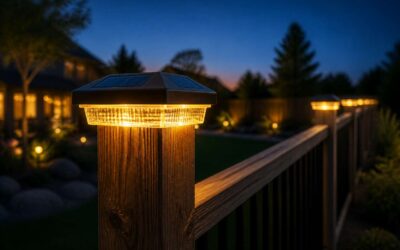
Post cap lights turn ordinary fence posts into silent sentinels. They mark the edge of a solar lights patio with a steady glow, a line of small beacons that hold the night at bay. Unlike wall fixtures, these units work from above. They cast light downward and outward, tracing the shape of the space.
- Solar panels built directly into the cap
- Automatic dusk to dawn sensors
- Weatherproof housings rated for coastal air
The effect is subtle but definite. Walking past a row of lit posts feels different. The boundary becomes visible. The dark recedes a little further.
Factors to Consider When Selecting Solar Lighting for Your Patio
Sun Exposure and Charging
When selecting solar lights patio, the first factor is not the fixture itself but the path of sunlight across your outdoor space. In South Africa, our radiation levels are high, yet a wall or overhanging branch can drastically reduce charging capacity. I learned this when my best modules sat in shade for half the day.
Consider the actual charging window. Solar cells need at least four to six hours of direct sun, not filtered light. The orientation of your patio matters more than the wattage rating.
- Roof overhangs that create partial shade
- Neighboring trees or buildings
- Seasonal shifts in the sun’s angle
These variables decide whether your solar lights patio will glow past midnight or fade by nine. Rechargeable batteries store the day’s harvest, so a poor placement means a long dim evening.
Brightness and Color Temperature
A patio without proper lighting is just a place where spiders congregate. But choosing the wrong brightness for your solar lights patio can ruin a braai. Lumens dictate intensity. For dining areas, 100 to 200 lumens creates comfortable visibility. For steps or pathways, 50 to 100 lumens works.
Color temperature matters equally. Measured in Kelvin, this determines mood. Warm white at 2700K matches the spectrum of old incandescent bulbs. Cool white at 5000K boosts alertness but reduces the appeal of food.
Consider these common ranges:
- Warm white below 3000K for relaxation zones
- Neutral white between 3000K and 4500K for versatile areas
- Cool white above 4500K for security lighting
The best solar lights patio setups mix temperatures deliberately. Your outdoor bar wants warmth, while your driveway wants clarity. Match the Kelvin to the purpose, and your evenings remain legible and pleasant.
Battery Capacity and Durability
Battery capacity determines how long your solar lights patio will perform after sunset. A lithium iron phosphate cell holds charge more steadily than older nickel based batteries. Look for capacities above 2000mAh for extended evenings. In South Africa, winter daylight hours shrink dramatically, so a robust reserve becomes essential.
Durability requires attention to ingress protection ratings. An IP65 fixture resists dust and water jets, while IP67 tolerates temporary submersion. For a solar lights patio near the coast, corrosion resistant housings are non negotiable. Powder coated aluminium or marine grade stainless steel outlast plastic alternatives in salt laden air.
Consider the charging cycle as well. Some batteries degrade after a few hundred charges, reducing runtime. Replaceable battery compartments offer a practical advantage, allowing you to refresh the unit without replacing the entire fitting.
- Check the battery type and capacity before purchase
- Verify the IP rating against your local weather patterns
- Confirm whether batteries are user replaceable
Weather Resistance
South African weather destroys inadequately protected fixtures quickly. UV radiation breaks down polycarbonate lenses within two years, leaving your solar lights patio with yellowed, brittle housings. Coastal regions demand housings sealed against salt aerosol infiltration, while Highveld users face hail impacts and thermal cycling that crack substandard seals.
Consider the glazing material used in each fitting. Tempered glass withstands hailstones better than acrylic, although it adds weight to mounting arms. Gaskets should be silicone based, as EPDM perishes under intense sun exposure. Fastener quality matters too; stainless steel screws resist corrosion where zinc plated equivalents fail within months.
- UV stabilised polymers in the housing
- Operating temperature range covering your region’s extremes
- Silicone based gasket material
- Corrosion resistant fastener grades
These factors determine whether your solar lights patio investment survives a full decade or fails during the first storm season.
Style and Aesthetic
Style is where most solar lights patio purchases go wrong. Homeowners obsess over lumens and battery life, then mount a clunky plastic fitting on a beautiful timber pergola. The mismatch is painful to look at!
Your patio style dictates everything. A Cape Dutch home with decorative gables demands lantern silhouettes. Industrial outdoor spaces need angular, exposed metal. Coastal bungalows suit weathered bronze, never glossy black plastic.
Proportion matters too. A shoebox-sized light on a slender beam looks clumsy. Scale should follow architecture.
When checking solar lights patio fixtures for aesthetic fit, I examine several things:
- How the finish holds up to dust and finger oils
- The LED’s colour temperature, which shapes the mood
- Whether mounting brackets sit flush or stick out awkwardly
- How the fixture looks at midday, when it’s switched off
A light is judged at night, but it lives in your garden all day.
Installation and Placement Tips for Optimal Performance
Positioning for Maximum Sunlight
Placement is a quiet ritual of patience and precision. The sun is not an ally that forgives neglect, so you must treat your solar lights patio like a stage where the light performs its slow, deliberate ballet. Shadows from walls, hedges, and even the eaves of your home will steal the charge before the evening ever arrives. Map the sun’s arc across your garden for a few days, marking where the glow retreats first. These spots are your enemy, and you will avoid them.
Position each fixture to face north if you can, a subtle trick that captures the midday heat without the harsh glare of afternoon. If you live in a region where winter clouds loom low, tilt the panel toward the equator. The angle matters more than you think. A flat panel may look tidy, but it will starve the battery.
To keep the performance sharp, consider these points:
– Trim overhanging branches that cast a moving patchwork of shade.
– Place fixtures at least a meter away from bright windows to avoid confusing the dusk sensors.
– Clean the panels with a dry cloth monthly to remove the film of dust that gathers like memory.
The placement of your solar lights patio is not a single event, but a conversation with the changing seasons. A light that thrives in the long, amber days of summer may falter when the shadows lengthen in winter. Revisit the arrangement when the clocks change, and nudge the heads of each fixture to catch the weaker, angled light. The reward is a dependable, eerie glow that begins as the world goes dark.
Spacing and Arrangement
Arrangement is where the character of your solar lights patio truly takes shape. I have seen gardens where a dozen fixtures stand like lonely sentinels, each one isolated and weak. Spacing is not about filling every corner. It is about creating a rhythm of light and shadow that guides the eye and the feet. For a pathway, a distance of two to three meters between fixtures works well. This gap prevents a harsh, runway effect and instead casts a soft, welcoming glow that invites a slow stroll.
When planning the layout, consider the sightlines from your windows and seating areas. You want the view to feel composed, not scattered. Grouping three or four lights of varying heights near a bench or a flower bed creates a focal point that draws people into the space, rather than pushing them to the edges. For a solar lights patio used for entertaining, place fixtures near the edges of the entertaining zone to define the perimeter without throwing harsh glare into the conversation area.
A common mistake involves placing lights too close together. This creates a washed-out brightness that ruins the subtle ambiance. A better approach is to treat the darkness as a painting and the lights as brushstrokes. Consider these spacing rules for a balanced layout:
1. Measure the total length of your patio and divide it by the number of fixtures to achieve an even distribution.
2. For corners, place a light at least one meter from each wall to avoid a trapped, boxed-in feeling.
3. If you have a central dining area, keep fixtures at the periphery, aiming their glow inward for a warm, intimate setting.
The true test of your arrangement happens on a moonless night. Step outside and walk the path you have created. Note where the shadows pool too thickly and where the light feels excessive. Adjust the heads and angles accordingly. A solar lights patio is a living composition, and the best arrangement is one you refine through observation, not just a single afternoon of installation.
Mounting Options
Mounting determines whether a solar lights patio actually delivers. A fixed stake works on open ground, but a stoep with concrete requires a wall bracket with a swivel. I once corrected a customer’s weak glow by loosening the arm and turning the panel eastward for the morning sun.
Some mounts lift the panel above shadowing plants or balustrades. These include:
- A clamp for railings, which avoids drilling.
- A pole adapter for tall posts, offering a 360 degree rotation.
- A ground spike with an angled head, suitable for rocky soil.
Heat dissipation depends on the mount. A flush base traps warmth inside the battery housing. A raised mount encourages airflow and extends the unit’s lifespan. The mount’s design alters the solar lights patio’s performance and longevity.
Seasonal Adjustments
South Africa receives over 2,500 hours of sunshine annually, yet a solar lights patio underperforms when owners ignore seasonal shifts. A panel fixed at a summer angle loses charge by midwinter.
In Cape Town’s winter, the sun sits lower against the horizon. Adjust the panel to a steeper tilt, around 45 degrees, to capture the weaker rays. Upcountry, where summer thunderstorms roll in by late afternoon, position the panel to catch the morning window instead. A swivel bracket makes this a two minute task.
- Autumn: raise the panel angle before the equinox.
- Winter: trim branches that cast longer shadows.
- Spring: reset the tilt and clean the cells.
Dust from the Karoo wind or jacaranda pollen settles on glass and cuts output by a third. A monthly wipe with a damp cloth keeps the solar lights patio honest. These adjustments cost nothing, yet they determine whether the glow lasts past nine.
Troubleshooting Common Issues
The installation itself is where many solar lights patio schemes falter. A fixture driven into hard, compacted soil stands crooked, its sensor angled toward the neighbour’s wall. Dig first. Loosen the earth. Set the stake true, then firm the ground around it. For wall mounted units, use rawl plugs suited to plaster or brick, never cheap adhesive strips. Cape Town’s south easter will tear them off by Tuesday.
Troubleshooting usually comes down to three culprits:
1. Dead cells after a long overcast stretch.
2. Corroded battery contacts.
3. The switch left on during shipping.
Most units arrive with a protective film over the panel. Peel it off. If the light flickers and dies within an hour, the battery needs conditioning. Charge it fully during daylight, then let it drain completely over two nights. Repeat once. The solar lights patio will operate reliably after that.
Creative Ways to Integrate Solar Lighting into Your Patio Design
Ambient Lighting for Evenings
As the South African sun sets behind the koppies, the patio takes on a new role. Ambient lighting dictates the mood here. Instead of relying on a single overhead source, I encourage layering your solar lights patio fixtures to create depth through shadow and silhouette. Position lower output units behind potted ferns to cast patterned shadows across stone floors. Place a warm tone unit near a water feature to catch the ripples! The effect should feel incidental, almost accidental, not curated. For a truly immersive evening, consider these approaches:
- Place units inside glass jars or woven baskets to diffuse the glare.
- Angle fixtures upward into trees to create a soft canopy glow.
- Use motion sensor units near seating areas so light arrives only when needed.
The result is a space that feels inhabited after dark, not merely illuminated. Your solar lights patio should remain subtle, creating pockets of quiet luminescence that invite lingering conversations.
Highlighting Architectural Features
In a 2024 survey of Cape Town homeowners, 71% said architectural details are the most overlooked feature when planning outdoor lighting. For South African patios with exposed stone cladding or Cape Dutch gables, the right placement of solar lights patio units transforms texture into a nightly feature. I often angle slim-profile spotlights upward along masonry surfaces to create wall grazing. This technique deepens mortar joints and brings relief to flat planes. On patios with timber pergolas, mount warm-toned units on the underside of beams to echo the grain. Some arrangements create stronger architectural framing:
- Fixtures at the base of structural pillars elongate their vertical presence.
- Units directed toward a chimney breast or braai flue give the patio a focal point after dark.
A staggered arrangement works best, avoiding uniform spacing that flattens the architecture. The result is a solar lights patio scheme that feels deliberate without losing its natural evening character.
Creating a Cozy Atmosphere
Cozy outdoor evenings rarely happen by accident. They are composed, layer by layer, with intent. For a Cape Town patio, the shift from daylight to dusk is a quiet theatre, and solar lights patio units play the supporting cast. Instead of placing fixtures where they are most visible, tuck them where they surprise: behind a potted strelitzia, beneath a wooden bench, or inside a gap between stacked stone. This creates pockets of warmth without flattening the space into a showroom.
The best solar lights patio schemes feel discovered, not staged. A single warm glow near a braai corner draws people toward conversation. Another source low along a planter edge softens the transition between hard surfaces and garden. When the eye moves through these small pools of light, the patio gains depth. The result is an evening space that feels inhabited, not merely illuminated.
Combining with Other Light Sources
A single overhead bulb is the social equivalent of a raised eyebrow: it demands attention and forgives no one. The better approach is to let your light sources perform in tandem. For the Cape Town evening, a solar lights patio arrangement works beautifully when it shares the stage with a low voltage lamp or a stubbornly romantic candle. Let the solar units claim the edges, the steps, the distant planter. Let the warmer, steadier sources own the faces around the table. The division need not be even.
Consider these unions that work well:
- Solar lights for the long boundary line, a table lamp for the card game.
- A lantern on the sideboard, solar lights patio units tucked into the planters behind it.
- Wall sconces for the braai corner, solar units marking the path to the herb garden.
The result is a hierarchy of glow. It gives the eye a route to follow and a place to rest. That is the quiet luxury of a patio that feels lived in, not merely switched on.
Safety and Security Enhancements
A dark patio invites hesitation. In South Africa, where load shedding makes dependable lighting unpredictable, the solar lights patio installation becomes a functional safeguard. Position units at ankle height along a stair stringer, or nestle them into a pebble border. These placements turn a practical fixture into a design element.
For security, eliminate blind spots while preserving the evening’s mood. A solar unit inside a hollow planter, its glow washing upward across a wall, softens the architecture and signals occupancy. Consider these placements:
- Inside the lip of a raised flower bed to silhouette the foliage.
- Along a gate latch, so the mechanism is legible from a distance.
- Under a built-in bench, casting a low perimeter light that discourages lurking.
The result is a patio that feels observed, not interrogated. A solar lights patio unit, placed with intention, becomes a quiet boundary.

0 Comments